An Impolite Interview with Norman Mailer
Paul Krassner's eleven-page Q&A with Mailer, the longest interview Mailer had given to date — running on the cover of The Realist no. 40 (December 1962) and continuing across pages 13-16, 18-23, and back to p. 10. Mailer's positions on the hipster, totalitarianism, the FBI and CIA, the Kennedy administration, Cuba and Castro, sexuality, masturbation, the Negro question, mysticism, and Zen and the art of thumb-wrestling. Reprinted partially in The Presidential Papers (63.37), The Idol and the Octopus (68.11), and Pieces and Pontifications (82.16), and complete in Best of 'The Realist,' ed. Paul Krassner (Philadelphia: Running Press, 1984). See 93.8b.
Read an excerpt (rights pending)
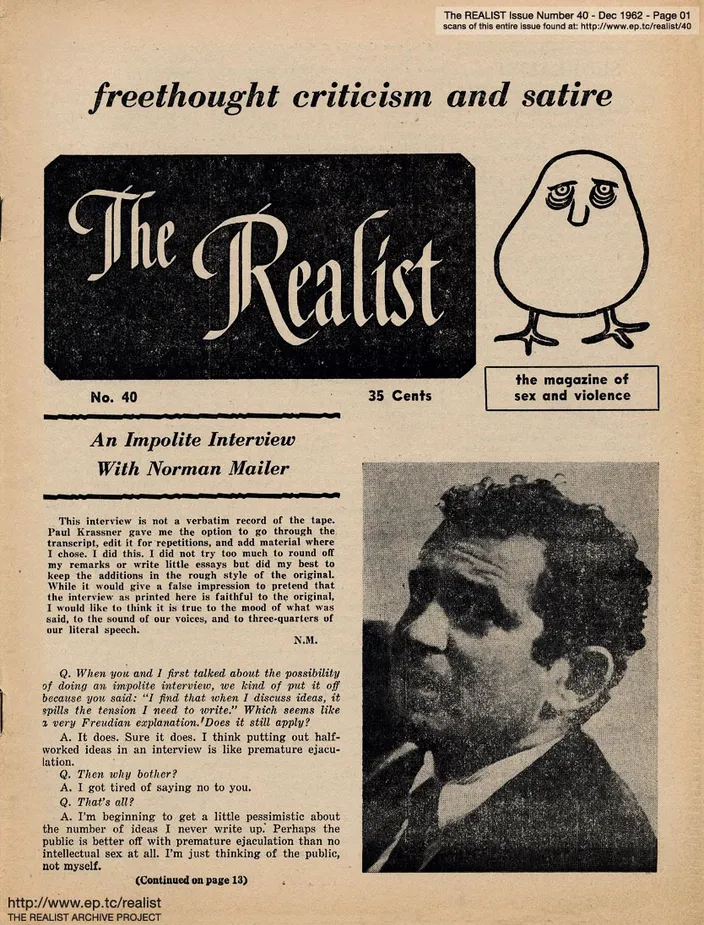
“An Impolite Interview with Norman Mailer.” By Paul Krassner. The Realist, no. 40 (December 1962), 1, 13–16, 18–23, 10.
The Realist’s “Impolite Interview” series was Krassner’s signature feature in the magazine — a deliberately confrontational, multi-hour Q&A — and the December 1962 Mailer installment is the longest single interview Mailer had given to that date. The piece runs across eleven magazine pages, from the cover (alongside a Mailer portrait) through pp. 13–16, 18–23, and ends back on p. 10. Krassner’s standard interview-arc bears down hard: Mailer is asked, in turn, about the hipster and the beatnik, drugs and character, sexuality and gender, the half-worked idea, the FBI, the CIA, the Kennedy administration’s response to Cuba and the Bay of Pigs, the bomb and Civil Defense, masturbation, the “Negro question,” and — at the close, by way of the conversational off-ramp Krassner so often used — Zen and the art of thumb-wrestling.
Editorial framing
Mailer’s prefatory note (lifted into the magazine’s opening text) names his standard interview-with-Krassner posture:
This interview is not a verbatim record of the tape. Paul Krassner gave me the option to go through the transcript, edit it for repetitions, and add material where I chose. I did this. I did not try too much to round off my remarks or write little essays but did my best to keep the additions in the rough style of the original. While it would give a false impression to pretend that the interview as printed here is faithful to the original, I would like to think it is true to the mood of what was said, to the sound of our voices, and to three-quarters of our literal speech. — N.M.
The interview’s arc, in brief
The Q&A is organized thematically rather than topically (though it drifts):
On the hipster and on writing. Mailer’s first answer locks in: “I think putting out half-worked ideas in an interview is like premature ejaculation.” He goes on to complain that he is “beginning to get a little pessimistic about the number of ideas I never write up” — and to develop his standard position on the difference between intellectual conversation and “the writing peace I need to write.” On hipsters and Christmas: an evocation of how a Limited Edition of playing cards created especially for the friends of Time magazine helps clarify the distinction between hipster and beatnik.
On the FBI and police organization in America. Mailer’s position, sustained across several Q&A’s: J. Edgar Hoover’s Bureau organizes the country into “an enormous sexual totalitarianism,” and the half-conscious connection between the FBI and the conformist sexuality of the 1950s is the structural fact that has not been adequately examined. His distinction between fascism and totalitarianism — fascism as an old, frank, and visible tyranny; totalitarianism as the new, polite, hidden one — is given here in some of its earliest published form.
On the CIA and the Cuban operations. Mailer’s reading of the Bay of Pigs (April 1961) and the unfolding Cuban Missile Crisis (October 1962, just two months before the interview’s publication): the CIA, “an enormous gross plague,” is one of the cancer growths of the country at large. He thinks Castro is a good man, and that “the great peril for America” in 1962 was its inability to recognize Castro as anything but a Communist.
On JFK and on the Kennedys. A mixed verdict — somewhere between the open admiration of “Superman Comes to the Supermarket” (60.9) and the eventual disenchantment of “The Existential Heroine” (62.12) and what would become The Presidential Papers (63.37). “He’s not a true existentialist; he’s a Catholic boy from Harvard.”
On Civil Defense, the bomb, and apocalyptic literature. The book of Mailer’s that ought to have been written and never was. Krassner: “Is there such a thing as good bombing literature?” Mailer: “I haven’t seen it.”
On masturbation and adolescent sexuality. The interview’s most-quoted exchanges, then and since. Mailer’s position: masturbation as a habit that “doesn’t lead to existential fulfillment” but rather to a peculiar specific kind of half-life. The exchange runs through Krassner’s standard questions about teenage and college sexuality. Mailer’s verdict on the standard adolescent escapes of his time — “There’s a tendency to get a little pessimistic about the number of ideas I never write up” — and his admonition that “any attempt to apply rationality” to sexuality “may have grave consequences.”
On the Negro question. The longest sustained sequence in the interview, the one that connects most directly to “The White Negro” (57.4) and the “Blacks” reviews (61.6). Mailer reaffirms the central thesis of “The White Negro”: that “the Negro” — Mailer’s term, in 1962 — has had to live closer to the existential edge of American life than white America, and that the white hipster’s task is to inherit some of that hard-won knowledge.
On mysticism, Zen, and thumb-wrestling. The interview closes with a long Mailer riff on the difference between rationalism and mysticism: “Any mystic who’s worth a damn is animal. You can’t trust a mystic who gets there on drugs. I had mystical experiences on drugs, and great was my horror when I discovered I couldn’t have them without the drugs.” Final Q&A, after Krassner notes that Mailer has beaten him two-out-of-three in thumb-wrestling matches over the course of the interview: would he care to expound briefly on Zen in the art of thumb-wrestling? Mailer: “They are the same.”
Reprintings
Partial reprints in The Presidential Papers (63.37) — typically the sections on JFK, Civil Defense, and the Negro question — and in The Idol and the Octopus (68.11) and Pieces and Pontifications (82.16). The complete interview was reprinted in Best of “The Realist,” edited by Paul Krassner (Philadelphia: Running Press, 1984), 42–68.
Full text
A working draft transcription of the full interview from The Realist no. 40 (cover through p. 23, December 1962) is at full text; it awaits verification against the 1984 Best of “The Realist” reprint.
Related pages
- 1962 | The Realist | Paul Krassner | The White Negro | The Presidential Papers
- Confessions of a Raving, Unconfined Nut: Misadventures in the Counter-Culture (93.8b)
- Superman Comes to the Supermarket (60.9) | An Evening with Jackie Kennedy: Being an Essay in Three Acts (62.12) | The Blacks (61.6) | The Idol and the Octopus: Political Writings by Norman Mailer on the Kennedy and Johnson Administrations (68.11) | Pieces and Pontifications (82.16)