1962
Mailer's year of third marriage and major literary infrastructure. Divorces Adele Morales in Juarez (late February) and secretly marries Lady Jeanne Campbell on 4 May; in late spring they move into 142 Columbia Heights, Brooklyn — the brownstone Mailer had purchased in 1960 and will live in until his death. Publishes Deaths for the Ladies, his first book of poems (Putnam's, 30 March per the Works register; January per the published Days). Daughter Kate Cailean Mailer born to Jeanne on 18 August. Attends the Edinburgh International Writers' Conference 20–24 August, meeting Henry Miller and William Burroughs for the first time. Debates William F. Buckley Jr. in Chicago (22 September); covers the Patterson–Liston I championship fight (25 September) and the press-conference aftermath. Launches two parallel columns: The Big Bite in Esquire (November 1962 to December 1963) and Responses and Reactions in Commentary (December 1962 to October 1963). Krassner's eleven-page Impolite Interview appears in The Realist no. 40 (December). Separates from Lady Jeanne in late fall.
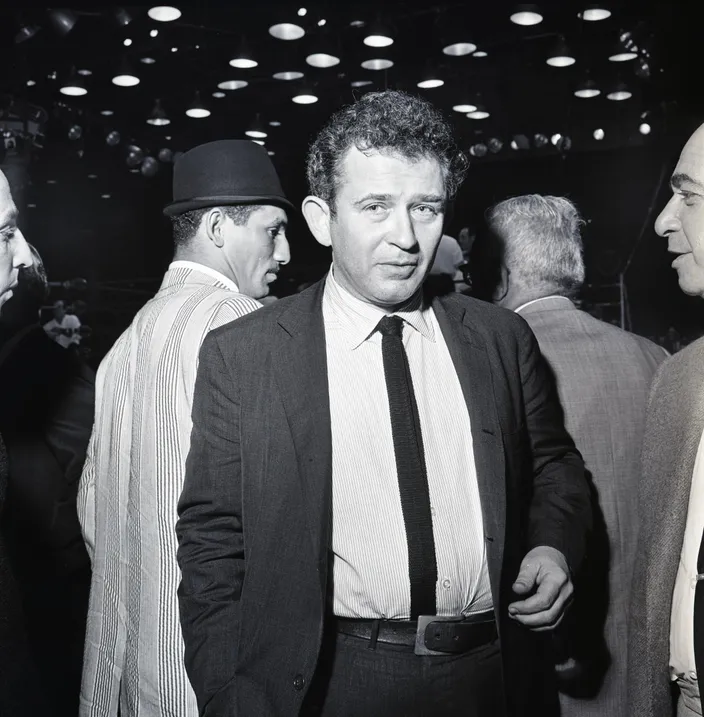
January — first appearance in the Atlantic, McGill Daily interview
January — The Atlantic prints five Mailer poems, his first appearance in the magazine (62.1): one titled “Testaments” and four untitled, opening “Men who are not married,” “I know the belly of Mexico,” “Promise? I won’t make a promise,” and “Poems written by masochists.” All five will be reprinted three months later in Deaths for the Ladies.
19 January — Reford MacDougall’s “Norman Mailer Speaks His Mind” appears in the McGill Daily Panorama (62.2) — a Montreal interview conducted in the living room of Robert Hershorn, publisher of Exchange Magazine, with reporters from The Star, Le Nouveau Journal, and the McGill Daily. Mailer on the hipster vs. the beatnik, on his literary influences (Tolstoy, Dostoyevsky, Marx, Trotsky, Stendhal, Freud, Forster, Isherwood, Wolfe, Dos Passos, Farrell, Steinbeck, Jones, Hemingway, Maugham, Sade), on Adolf Eichmann’s trial (“they should have assassinated Eichmann in South America”), on America-as-totalitarianism, and on himself as “an existentialist.”
February — Juarez divorce from Adele
February (late) — Mailer travels to Juarez, Mexico, and divorces Adele Morales (Lennon and Lennon 2018, p. 13). The two had been separated since March 1961.
March — Deaths for the Ladies; the Algonquin sit-down
4 March — At the Algonquin Hotel in New York, Mailer sits down with Martha MacGregor of the New York Post Magazine to discuss the soon-to-publish Deaths for the Ladies; his explanation of the deliberately unnumbered pages — “I want it to be a bit of a physical experience to read this book. You’ll have to do a lot of thumbing to find things. The book will be dog-eared, what every author wants” — runs in MacGregor’s column on the same day (62.5).
12 March — Newsweek’s “Two Bucks — 20 Dances” review-interview (62.5a) — by an unidentified writer — captures Mailer in three of his recurring 1962 self-characterizations: he’s “an amateur poet” (“When it comes to poets like a Yeats — I play fraternity house piano”); America is on its way to becoming “the finest and most exquisite expression of totalitarianism”; and the Twist must be answered with “I propose the Resist!”
30 March — Deaths for the Ladies (and Other Disasters) is published by G. P. Putnam’s Sons in New York and simultaneously by André Deutsch in London (softcover only), per Lennon’s Works register (62.3). Lennon’s Days (p. 13), however, places the book in January 1962, and the Gale bibliography (1986) gives the year only; this page follows the Works register’s 30 March date. Charles Simmons’s poem-review of the book in Time, 30 March 1962, will prompt Mailer’s reply six days later (62.8).
April — Lady Jeanne, the gossip columns, Time poem-letter
February 1 ago — Village Voice prints Mailer’s poem “A Glass of Milk” (62.4).
April — Six of Mailer’s Deaths for the Ladies poems are reprinted in Seymour Krim‘s Nugget under the title “Art of the Short Hair: Poetry by Norman Mailer”; Krim’s editorial-director column in the same issue (“The Man’s World,” 62.7) quotes Mailer (92 words) on his recent trip to England: “London is now like New York was in 1948.”
3 April — Queen (London) prints Mailer’s poem “Last Word on Love: Ode to Lady J.” (62.6) — a love poem to Lady Jeanne Campbell published, in retrospect, one month before their 4 May secret marriage.
6 April — Time prints Mailer’s “Poem to the Book Review at Time” (62.8), his poem-letter response to Charles Simmons’s 30 March poem-review of Deaths for the Ladies.
26 April — New York Post: Fern Marja Eckman and Alfred G. Aronowitz’s article-interview “Wed to Lady Jean? A Mystery, by Norman Mailer” (62.9) confirms the Juarez divorce from Adele but holds the marriage to Lady Jeanne in mystery: “There’s a theory that Jeanne and I both love a mystery, and that’s why we’re keeping a firm secret on the little matter — whether we’re married or not.”
29–30 April — Cholly Knickerbocker in the New York Journal-American (29 April) and Suzy in the New York Mirror (30 April) identify “Lady J” as Lady Jeanne Campbell and report — accurately — that Mailer and Campbell have married.
May — the third marriage
4 May — Mailer and Lady Jeanne Campbell secretly marry, per the published Lennon Days (p. 13). The date is the same calendar date on which, the year before, Mailer had pleaded guilty in the Adele assault case (per Lennon Works 61.5a) — a coincidence the project has flagged for backlog verification.
18 May — New York Times prints an unsigned article (62.10) in which Mailer at last confirms the marriage to Lady Jeanne, “for some time.”
Late spring — Mailer and Lady Jeanne move into 142 Columbia Heights, Brooklyn — a four-story brownstone Mailer had purchased in 1960 and will live in until his death on 10 November 2007, except for sojourns in Provincetown (where he will live the majority of his time during the last decade of his life).
June — Womanization of America
June — Playboy publishes Mailer’s “The Womanization of America” (62.11), a symposium contribution running over thirteen pages of the issue. Mailer’s second appearance in Playboy after the previous July’s “Sex and Censorship” (61.8).
July — An Evening with Jackie Kennedy
July — Esquire publishes Mailer’s “An Evening with Jackie Kennedy: Being an Essay in Three Acts” (62.12), his second Kennedy-cycle essay after “Superman Comes to the Supermarket” (60.9), occasioned by Jacqueline Kennedy’s 14 February 1962 televised White House tour. Later titled “The Existential Heroine” for collection in The Presidential Papers.
11 July — Christian Century prints Mailer’s “Ex Libris” reply (62.12a) — eight books that shaped his vocational attitude and philosophy of life: Das Kapital Vol. I, War and Peace, The Red and the Black, The Function of the Orgasm, Lady Chatterley’s Lover, Man’s Fate, Captain Blood, The Amateur Gentleman.
August — Kate Cailean Mailer; Edinburgh
18 August — Daughter Kate Cailean Mailer is born to Lady Jeanne Campbell.
20–24 August — Mailer attends the Edinburgh International Writers’ Conference at McEwan Hall, organized by John Calder and Sonia Orwell as part of the Edinburgh International Festival. Mailer co-chairs the final day’s session, “The Novel and the Future,” and clashes with Mary McCarthy and Lawrence Durrell. First in-person meetings with Henry Miller and William Burroughs. The court stenographer’s mimeographed transcript (62.24) is the contemporary record; Andrew Hook’s limited-edition reprint, The Novel Today: Edinburgh International Festival 1962 (Edinburgh: Kennedy & Boyd), appears in 2012.
September — Evergreen Review; Buckley debate; Patterson–Liston I
September–October — Evergreen Review no. 26 carries Mailer’s first appearance in the journal: the short story “Truth and Being; Nothing and Time: A Broken Fragment from a Long Novel” (62.13). The subtitle anticipates the An American Dream serialization Mailer will begin running in Esquire in early 1964.
22 September — In Chicago, Mailer debates William F. Buckley Jr. for the first time, moderated by Irv Kupcinet, on the role of the right wing in American life. Talese’s account in the New York Times of 24 September (62.13a) places the line that will follow Mailer for years — “It is the right wing that wishes to blow up the earth” — alongside Buckley’s reply that Mailer is “a writer of genuine talent who was also the most politically ignorant man I have ever met.” (Pete Hamill’s NY Post account of the same day: 62.13b.)
25 September — Mailer covers the Floyd Patterson–Sonny Liston heavyweight championship fight in Chicago for Esquire. Pre-fight, Leonard Shecter‘s NY Post column (62.14) quotes Mailer’s prediction that Patterson “will end it with one punch in the sixth.” In the event, Liston knocks Patterson out at 2:06 of the first round.
27 September — Mailer makes himself part of the post-fight story at Liston’s press conference. The exchange is covered the same day by Red Smith in the New York Herald Tribune (62.15), Stan Isaacs in Newsday (62.16 — “I Can Call You a Bum”), and Leonard Shecter again in the NY Post (62.17).
28 September — Mailer’s letter to the editor of the NY Herald Tribune (62.17a) complains of inaccuracies in Smith’s column: “I was neither drunk nor offensive.”
29 September — Leonard Lewin’s “U.S. Perils Return Bout” in the New York Mirror (62.17b) closes the press-conference cycle. Mailer to Liston: “I pick Floyd Patterson to knock you out in the sixth.” Liston replied, “He’s still drunk.”
The fight will produce Mailer’s first sustained boxing essay, “Ten Thousand Words a Minute” (63.3), in the February 1963 Esquire.
November — The Big Bite launches
November — Esquire launches Mailer’s monthly column “The Big Bite” (62.18). The first installment comments on the deaths of Marilyn Monroe (5 August 1962) and Ernest Hemingway (2 July 1961). The column will run fourteen consecutive months through December 1963 (62.18, 62.19, 63.2 through 63.13).
December — Big Bite II; Sad Saint; Impolite Interview; Responses and Reactions; Open Letter to JFK
December — A six-piece December:
- Esquire prints “The Big Bite” II (62.19) on the suicides of the spy Henry Soblen and Ernest Hemingway and on American heroism as manifested by astronaut John Glenn, with the poem “Sing the Ballad of the Sad Saint” (62.20) on the facing page.
- The Realist no. 40 carries Paul Krassner‘s eleven-page “An Impolite Interview with Norman Mailer” (62.21) — the longest Q&A Mailer has given to date.
- Commentary launches Mailer’s second running column, “Responses and Reactions” I (62.22) — bi-monthly through October 1963 (62.22, 63.16, 63.17, 63.18, 63.19, 63.20), devoted mainly to commentary on Martin Buber’s Tales of the Hasidim. From this month through December 1963 Mailer is publishing one column per month in Esquire and one bi-monthly column in Commentary.
- Reader’s Encyclopedia of American Literature (T. Y. Crowell, 1962), ed. Max John Herzberg, prints Mailer’s entry (62.25) with the “Comments” statement naming Stendhal, Tolstoy, and D. H. Lawrence as the writers who have meant most to him in forming a style.
- 20 December — Village Voice prints Mailer’s “An Open Letter to JFK from Norman Mailer” (62.23) on the front page — Mailer’s second front-page Voice open letter to Kennedy after the 27 April 1961 “Open Letter to JFK and Castro” (61.5), and one of the year’s most direct public engagements with the post–Bay-of-Pigs, post–Cuban-Missile-Crisis presidency.
Late fall — separation from Lady Jeanne
In late fall Mailer separates from Jeanne Campbell (Lennon and Lennon 2018, p. 13). The third marriage will be formally dissolved in Juarez on 16 December 1963.
Related pages
- 1961 | 1963
- Deaths for the Ladies (and Other Disasters) | An Evening with Jackie Kennedy: Being an Essay in Three Acts | An Impolite Interview with Norman Mailer | Conference Remarks (Edinburgh International Writers' Conference) | Responses and Reactions I | The "Big Bite"
- Lady Jeanne Campbell | Kate Cailean Mailer | 142 Columbia Heights, Brooklyn | William F. Buckley Jr. | Sonny Liston | Floyd Patterson | Henry Miller | William S. Burroughs
- Poems (62.1) | Norman Mailer Speaks His Mind (62.2) | The Week in Books (62.5) | Two Bucks — 20 Dances (62.5a) | Poem to the Book Review at Time (62.8) | A Glass of Milk (62.4) | The Man's World (62.7) | Last Word on Love: Ode to Lady J. (62.6) | Wed to Lady Jean? A Mystery, by Norman Mailer (62.9) | Judge Gives Mailer a Break (61.5a) | Norman Mailer Confirms Marriage to Lady Jean (62.10) | The Womanization of America (62.11) | Sex and Censorship in Literature and the Arts (61.8) | Superman Comes to the Supermarket (60.9) | Ex Libris (62.12a) | Truth and Being; Nothing and Time: A Broken Fragment from a Long Novel (62.13) | Mailer Debates William Buckley: Chicago Political Bout a Draw (62.13a) | Mailer vs. Buckley: Good Fight, No Decision (62.13b) | The Literate at the Fight (62.14) | The Big Fight (62.15) | Liston and the Author: 'I Can Call You a Bum' (62.16) | The Prizefighter and the Author (62.17) | Letter to the Editor (62.17a) | U.S. Perils Return Bout (62.17b) | Ten Thousand Words a Minute (63.3) | The "Big Bite" (62.19) | The "Big Bite" (63.2) | The "Big Bite" (63.13) | Sing the Ballad of the Sad Saint (62.20) | Responses and Reactions II (63.16) | Responses and Reactions III (63.17) | Responses and Reactions IV (63.18) | Responses and Reactions V (63.19) | Responses and Reactions VI (63.20) | Norman Mailer (62.25) | An Open Letter to JFK from Norman Mailer (62.23) | An Open Letter to JFK and Fidel Castro (61.5)
Referenced by 49
Works
- A Glass of Milk
- An Evening with Jackie Kennedy: Being an Essay in Three Acts
- An Impolite Interview with Norman Mailer
- An Open Letter to JFK from Norman Mailer
- Conference Remarks (Edinburgh International Writers' Conference)
- Deaths for the Ladies (and Other Disasters)
- Ex Libris
- Last Word on Love: Ode to Lady J.
- Liston and the Author: 'I Can Call You a Bum'
- Mailer Debates William Buckley: Chicago Political Bout a Draw
- Mailer vs. Buckley: Good Fight, No Decision
- Norman Mailer
- Norman Mailer Confirms Marriage to Lady Jean
- Norman Mailer Speaks His Mind
- Poem to the Book Review at Time
- Poems
- Responses and Reactions I
- Sing the Ballad of the Sad Saint
- The "Big Bite"
- The "Big Bite"
- The Big Fight
- The Literate at the Fight
- The Man's World
- The Prizefighter and the Author
- The Week in Books
- The Womanization of America
- Truth and Being; Nothing and Time: A Broken Fragment from a Long Novel
- Two Bucks — 20 Dances
- U.S. Perils Return Bout
- Wed to Lady Jean? A Mystery, by Norman Mailer