Understanding Norman Mailer
Maggie McKinley's Understanding Norman Mailer (University of South Carolina Press, 2017) — billed as the first book of literary criticism to address Mailer's entire body of work, from his first publication to his last. A compact, career-spanning critical introduction in USC Press's Understanding Contemporary American Literature series. The first single-author critical monograph in the register; recorded with kind `about`.
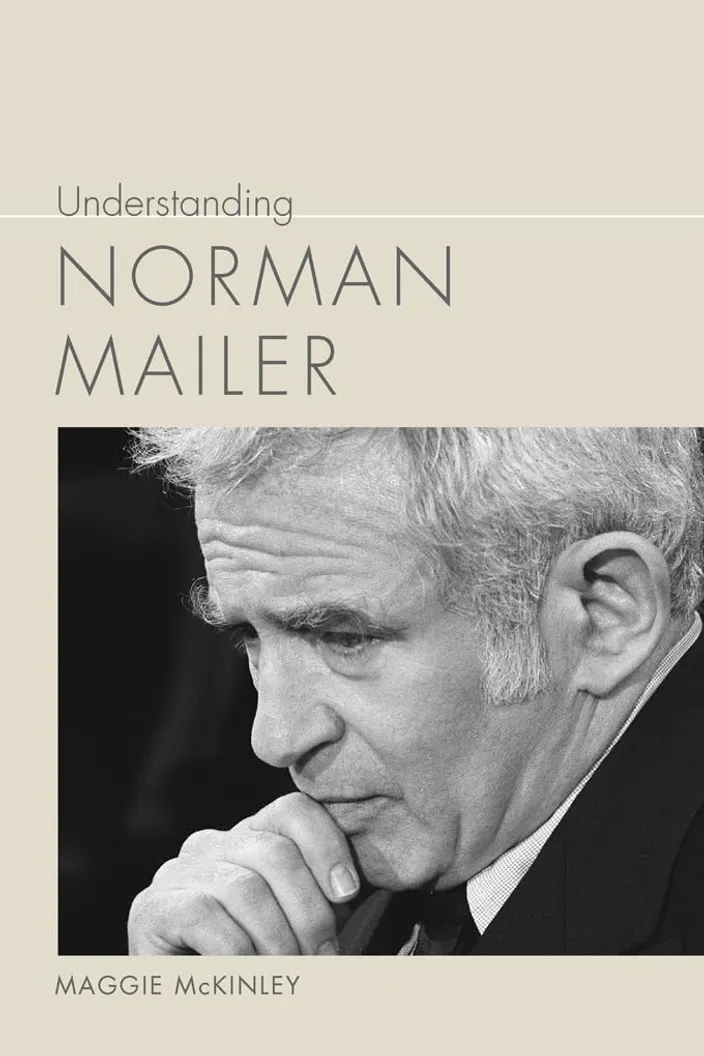
Maggie McKinley. Understanding Norman Mailer. Columbia, SC: University of South Carolina Press, 6 November 2017. 152 pp. ISBN 978-1-61117-805-0 (cloth); 978-1-61117-806-7 (eBook). Understanding Contemporary American Literature series (founded by Matthew J. Bruccoli; series editor Linda Wagner-Martin). The book is dedicated, in part, to “Mike Lennon and everyone involved with the Mailer Society” (McKinley 2017).
A career-spanning critical study — “the first book of literary criticism to address Mailer’s impressive body of work in its entirety, from his first publication to his last”. Moving chronologically through Mailer’s roughly forty books and sixty-year career, McKinley situates the work in its historical and cultural context and traces “the major themes and philosophies that pervade Mailer’s canon, analyzing his representations of gender, sexuality, violence, technology, politics, faith, celebrity, existentialism, and national identity”. The book is pitched as an accessible introduction while attending to “the development and changes within Mailer’s ideas over time.”
Many of the themes McKinley organizes her chapters around are the same threads this project tracks as tags and Concept pages — existentialism, violence, celebrity, totalitarianism — and several reach back to the 1950s touchstones, the White Negro essay and Advertisements for Myself.
Method and structure
McKinley opens with one of Mailer’s favorite quotations, André Gide’s “Do not understand me too quickly,” and concedes the “certain irony in penning a book titled Understanding Norman Mailer” about an author who “resist[ed] any easy exegesis” (McKinley 2017, ch. 1). Her premise is that “the process of deriving meaning from literature is an ongoing project” in which “the answers are less important, perhaps, than the questions” — a stance she carries through to her final chapter, “Concluding with Questions.” She frames Mailer as a “genre maker” (borrowing Michael Johnson’s phrase) who “combined elements of … variant genres to create his own unique stylistic hybrids,” and she is careful not to “conflate the author with his protagonists or over-privilege the personal,” even as she grants that Mailer’s biography — his war service, his “spirituality (shaped but not dictated by his Jewish roots),” his “theories and anxieties about manhood,” his celebrity — “cannot be ignored” (McKinley 2017, ch. 1).
Conceived for students and “good nonacademic readers” in the Understanding Contemporary American Literature series, the book proceeds chronologically across seven chapters:
- “Understanding Norman Mailer” (life, career, and narrative style)
- “The Naked and the Dead and Its Aftermath”
- “An American Voice and An American Dream”
- “Mailer on War, Women, Politics, and Film”
- “Exploring American Mysteries: Mailer’s Interpretive Biographies”
- “The Divided Self across Genre: Novels of the 1980s and 1990s”
- “Concluding with Questions”
Reception
The volume drew notice as a foundational reference for Mailer studies. The Mailer Review called it “a needed antidote to academic fashion and prejudice”; the Association of College and Research Libraries praised it as “a compact introduction to the various facets of Mailer’s career, providing a jumping-off point for further study.” J. Michael Lennon — Mailer’s biographer and this project’s founding editor — judged McKinley’s “incisive, fair-minded examination… the first to look at all his major work… one of the best, an essential volume.” Among the other jacket endorsers is Gerald R. Lucas, editor of Project Mailer (and editor of this digital edition), who called it “what’s sure to be a key text in Mailer studies”.
The author
Maggie McKinley is an associate professor of English at Harper College and the author of Masculinity and the Paradox of Violence in American Fiction, 1950–75; her work has appeared in Studies in American Jewish Literature, Philip Roth Studies, and The Mailer Review, among other places. At the time of this book she served as vice president of the Norman Mailer Society. She went on to edit Norman Mailer in Context (Cambridge, 2021) and to contribute a jacket note to Lennon’s Mailer’s Last Days (2022). See Maggie McKinley.
A note on this entry
A secondary entry — a book about Mailer rather than by him — recorded in the bibliography with kind about. It is the register’s first single-author work of literary criticism, and prompted adding criticism to the Work form enum. Like other post-2016 additions it carries no legacy-id (see About this project). The listing price observed at capture was $29.99 (Amazon, new); binding and whether this is the list price are unconfirmed, so the price field is left blank.
Related pages
- Maggie McKinley | University of South Carolina Press | Norman Mailer in Context | Mailer's Last Days: New and Selected Remembrances of a Life in Literature | About this project