Norman Mailer at 100: Conversations, Correlations, Confrontations
Robert J. Begiebing's Norman Mailer at 100: Conversations, Correlations, Confrontations (Louisiana State University Press, 2022) — a hybrid single-author collection of critical essays, a dramatic dialogue, an imaginary interview, and Begiebing's own 1983 interview with Mailer, published for Mailer's 2023 centenary and the 75th anniversary of The Naked and the Dead. Winner of the Robert F. Lucid Award for Mailer Studies. Recorded in the register with kind `about`.
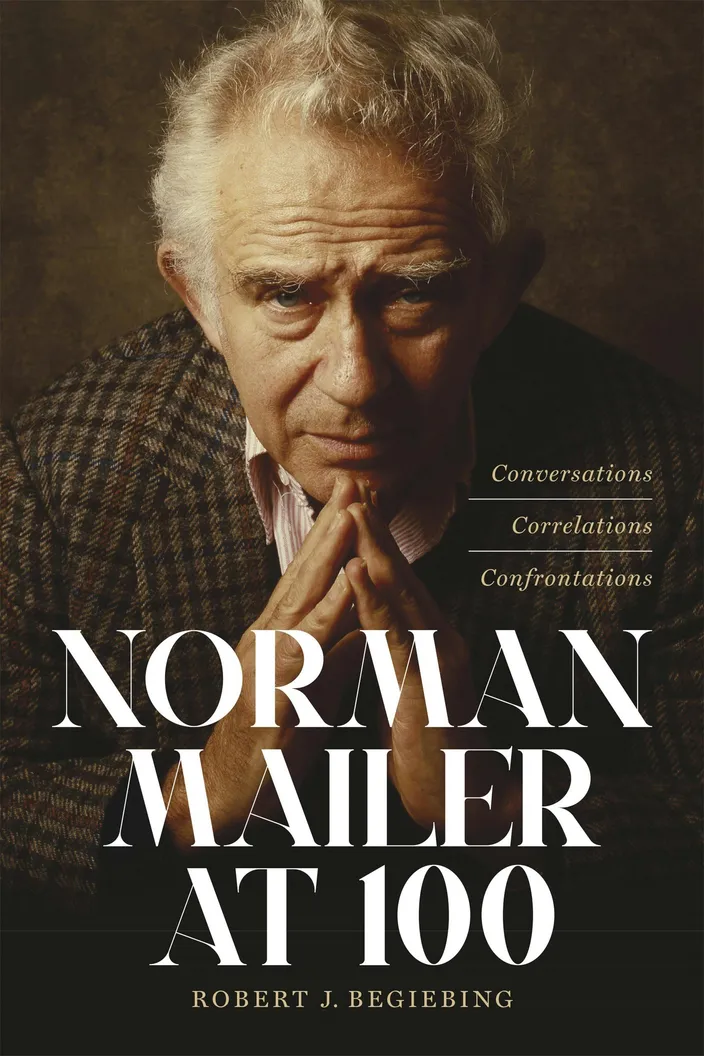
Robert J. Begiebing. Norman Mailer at 100: Conversations, Correlations, Confrontations. Baton Rouge: Louisiana State University Press, 23 November 2022. 248 pp., hardcover, $39.95 (eBook $19.95). ISBN 978-0-8071-7813-3 (hardcover); 978-0-8071-7895-9 (eBook). Winner of the Robert F. Lucid Award for Mailer Studies.
Begiebing conceived the book “to acknowledge and celebrate the 100th anniversary in 2023 of the birth of Norman Mailer,” a year that is also “the 75th anniversary of the publication of his first novel The Naked and the Dead, the book that launched him as if ‘shot out of a cannon’ … into literary celebrity” (Begiebing 2022, Preface). Its argument is that “in 2023 Mailer is still a provocative presence in American letters,” part of an American literary landscape reaching “from the debates of our founders, to the traditions of Western Romanticism, and to the whole juggernaut of twentieth-century modernism,” and “prescient in his social and political criticisms” (Begiebing 2022, Preface). The Lucid Award that the book won is named for Robert F. Lucid, Mailer’s archivist and an early compiler in this project’s own bibliographic lineage.
Contents and method
The volume is, in Begiebing’s words, “a hybrid collection of critical essays, a dramatic dialogue, an imaginary interview, and my interview with Mailer for Harvard Magazine” (Begiebing 2022, Preface). Across eight chapters it yokes Mailer to seven figures — Ralph Waldo Emerson, Walt Whitman, Carl Jung, Ernest Hemingway (twice), Kate Millett, Joan Didion, and the historian Joseph Ellis — “authors who help us open a way into Mailer’s life and work when we yoke them with Mailer through an essay or conversation.” Begiebing describes the book as “not without literary analysis but … largely contextual,” tracing “Mailer’s responses to literary influences, global and American politics, contemporary societies, economic inequity, and war” (Begiebing 2022, Preface). The mix of genres is itself a tribute to Mailer’s “working sense of the fluidity among genres” as an innovator of participatory and New Journalism.
The nine numbered chapters are:
- “Mailer and Hemingway: Epistolary Backgrounds to Their Generational War Novels”
- “Lipton’s Journal: Mailer’s Quest for Wholeness and Renewal”
- “Mailer and Millett: Sex Prison”
- “Mailer and Didion: Against Prevailing Winds”
- “Mailer and Emerson: Lipton’s Journal and the Dissident Soul”
- “Mailer and Whitman: The Interview on Democracy in America” (an imaginary interview)
- “Twelfth Round: Mailer on Boyhood, Harvard, and Ancient Evenings” (Begiebing’s 1983 Harvard Magazine interview)
- “Ernest and Norman: A Dramatic Dialogue in Two Acts”
- “Mailer and Joseph Ellis: Unsettling Dialogues on Democracy”
Two chapters (2 and 5) draw on the marijuana “Lipton’s Journal” of 1954–55 — the same document later published as Lipton’s, A Marijuana Journal (2024) — reading it as a record of Mailer’s “quest for wholeness and renewal” and of “the dissident soul.” The 1983 interview (chapter 7) is, Begiebing notes, “the only chapter that adds such a dimension of expansive biographical coverage,” ranging over Mailer’s Brooklyn boyhood, his Harvard years, the Army, and the decade-long composition of Ancient Evenings (Begiebing 2022, Preface).
Begiebing’s argument: “Does Mailer matter?”
The preface frames the book around that question. Begiebing answers it with Mailer’s honors — two Pulitzers, the National Book Award, the National Book Foundation Medal, the presidency of PEN America, the cofounding of The Village Voice, “some forty books,” and four produced films — and with testimony from other writers: William Kennedy (“the literary phenomenon of his generation”); Toni Morrison, who, even while noting Mailer’s “obtuseness regarding women,” called him a “carnivorous intelligence accompanied by huge and provocative talent” without whom “the history of American literature in the 20th and early 21st century would be both depleted and inaccurate”; David Remnick (“the American Balzac”); and Arthur Schlesinger Jr. (“one of the giants—if at times a wounded giant—of our age”) (Begiebing 2022, Preface). Begiebing stresses that Mailer “continually revises and reshapes his ideas, reinventing himself” — “on a journey” — which academic “gatekeepers” miss when they treat a book as “merely a concretized artifact.” Like David Denby in Eminent Jews, Begiebing locates a “prophetic tradition” as “the Jewish root of Mailer’s life and antinomian work,” casting Mailer as a “latter-day Jeremiah” (Begiebing 2022, Preface).
The author
Robert J. Begiebing is a novelist and Mailer scholar. He interviewed Mailer for Harvard Magazine in 1983, and in the preface recalls coming to Mailer in his twenties through The Naked and the Dead, Advertisements for Myself, The Presidential Papers, and Cannibals and Christians — “those books became my way in” (Begiebing 2022, Preface). His earlier criticism includes the study Acts of Regeneration: Allegory and Archetype in the Works of Norman Mailer (1980); a fuller, separately sourced account of his career is a backlog item. He also contributed a jacket note to J. Michael Lennon‘s Mailer’s Last Days (2022). See Robert J. Begiebing.
A note on this entry
A secondary entry — a book about Mailer — recorded in the bibliography with kind about. Form collection (a hybrid of essays, a dramatic dialogue, an imaginary interview, and a real interview). Like other post-2016 additions it carries no legacy-id (see About this project).
Dating note: the id uses 23 November 2022, the publication date given on LSU Press’s own product page for both the hardcover and the eBook (and matching the source filename). The clipping’s feed metadata carried a later date of 13 March 2023, which appears to be a distribution/wide-release date rather than first publication; if LSU’s catalog is later shown to differ, the id keeps its form and a previous-id alias is added.
Related pages
- Robert J. Begiebing | Louisiana State University Press | The Naked and the Dead | Lipton's, A Marijuana Journal | Advertisements for Myself | Mailer's Last Days: New and Selected Remembrances of a Life in Literature | Robert F. Lucid | About this project