The Naked and the Dead
Mailer's debut novel, a 721-page Pacific-theater war novel published by Rinehart on 6 May 1948, 62 weeks on the New York Times bestseller list, Pulitzer-nominated, and the book that made him a literary sensation at twenty-five.
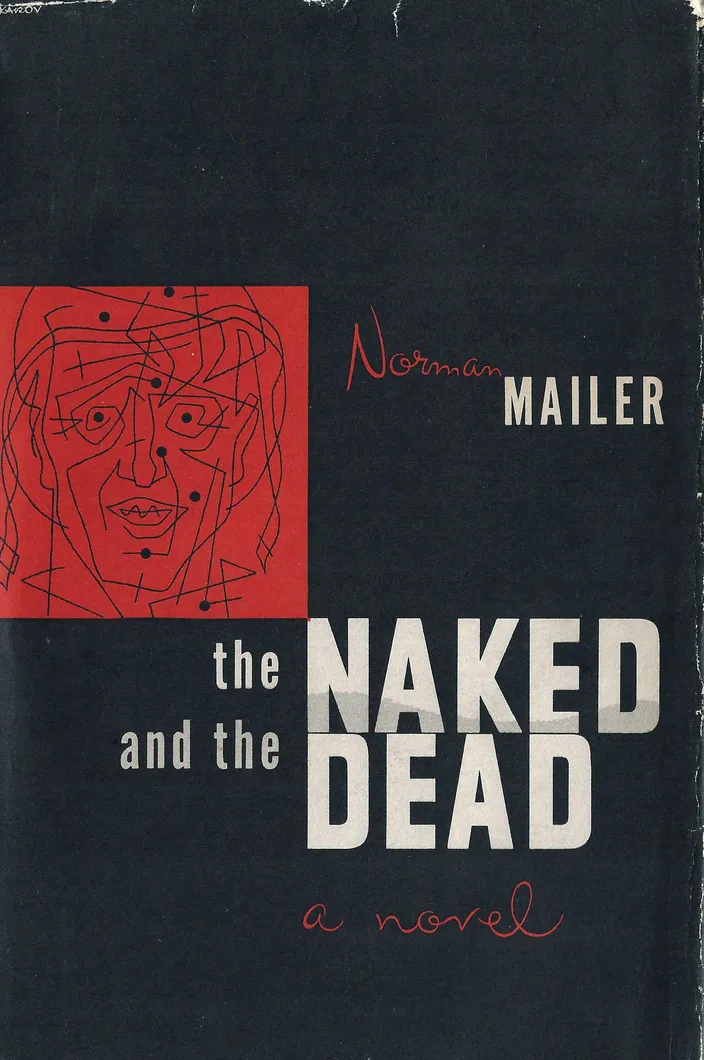
Publication
New York: Rinehart, 6 May 1948. 721 pages. $4.00. Dedicated and acknowledged by Mailer as follows: “To my Mother and Bea. I would like to thank William Raney, Theodore S. Amussen, and Charles Devlin for the aid and encouragement given me at various times in the writing of this novel”. “Bea” is Beatrice Silverman, Mailer’s first wife.
A London edition followed on 9 May 1949 from Wingate. Per Lennon’s convention, the UK first edition is recorded here rather than as a separate legacy entry.
The novel’s title was first used for an unpublished play about an insane asylum, based on a one-week job Mailer held at a Boston asylum in the summer of 1942.
An advance excerpt, running most of chapter 5, part 1 — the description of dragging the anti-tank guns through the jungle and the firefight at the river — appeared about a month earlier in Edwin Seaver’s anthology Cross-Section: A Collection of New American Writing (New York: Simon and Schuster, March 1948). That excerpt is catalogued separately as 48.1. It is labeled “work in progress” on the anthology’s dustwrapper.
Date discrepancy
Lennon gives the U.S. publication date as 6 May 1948 (48.2: “On May 6, The Naked and the Dead is published”).
Reception
The Naked and the Dead was on the New York Times bestseller list for 62 weeks, holding the top position for 11 consecutive weeks. It received a “Page One Award” from the New York Newspaper Guild (CIO affiliate) on 20 May 1949; was named one of the four best books of 1948 by Newsweek (13 December); was nominated by prominent critics for the Pulitzer Prize in the Saturday Review’s annual Pulitzer Prize poll (30 April 1949); was nominated for the Gutenberg Award; and the Associated Press named Mailer “Man of the Year” in Literature (reported in the Asbury Park Evening News, 31 December 1948).
Emmett Dedmon (Chicago Sun-Times), Lewis Gannett (New York Herald Tribune), John Henry Jackson (San Francisco Chronicle), Sterling North (New York Post), Charles Poore (New York Times), Fredric Melcher (Publishers Weekly), Orville Prescott (New York Times), Charles Rolo (Atlantic), and Karl Schriftgiesser (Newsweek) all listed it among the top ten books of the year; Jacques Barzun (Harper’s), Norman Cousins (Saturday Review), and Lon Tinkle (Dallas News) did not.
In a 5 December 1948 preference poll of forty well-known writers conducted by the New York Herald Tribune Weekly Book Review, seven respondents — Bartley Crum, James Hilton, Richard Lauterbach, Sinclair Lewis, Richard Match, Mary Roberts Rinehart, and Irwin Shaw — named The Naked and the Dead among their recent favorite reading. Only Greene’s The Heart of the Matter and Sherwood’s Roosevelt and Hopkins came close, each with five votes.
Sinclair Lewis, interviewed by Sylvia B. Richmond (Chelsea [Mass.] Record, 2 October 1948), was unrestrained: “Speaking of newcomers in the field — one of the greatest writers of today is young Norman Mailer, author of The Naked and the Dead — an amazing bit of writing. That boy has talent worth preserving. His writing has great sweep and an enormous scope. There’s nothing petty about Mailer — he’s the author of the hour — the greatest writer to come out of his generation”. Advertisements for Mailer’s books carried the “greatest writer to come out of his generation” phrase for years.
Life magazine offered an early countervailing note. A full-page editorial of 16 August 1948 criticized Mailer for “slumming” in the novel and for presenting the America of the “Time Machine” portions as “just as ugly, arid, boring and uncomfortable as a jungle campaign,” charging that Mailer “seems to tell us… that such purposes as marrying and procreating and raising a family or mastering an art or a profession or building a business or beating the Japs are without value to anybody now living.” A later Life editorial (16 April 1951) called the book “insidious slime.” Lennon flags these as “a harbinger of 50 years of preponderantly negative reviews from the Time-Life organization”. Mailer, according to Lennon, was pleased when his third wife Lady Jeanne Campbell — Henry Luce’s former mistress — told him that Luce “suffered a bit” on learning of her relationship with Mailer.
Among the most consequential early reception pieces, Maxwell Geismar’s laudatory review in Saturday Review (8 May) accompanied the magazine’s cover story on Mailer — Saturday Review’s first — and was paired with an article-interview by “R.G.” titled “The Author” (48.3).
Advertising
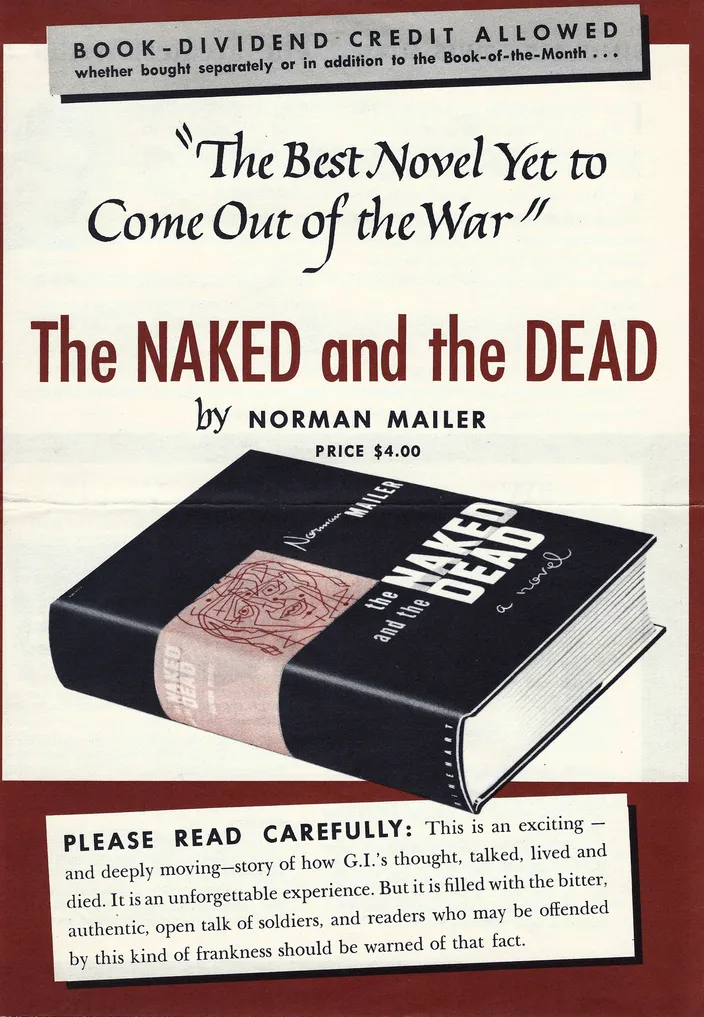
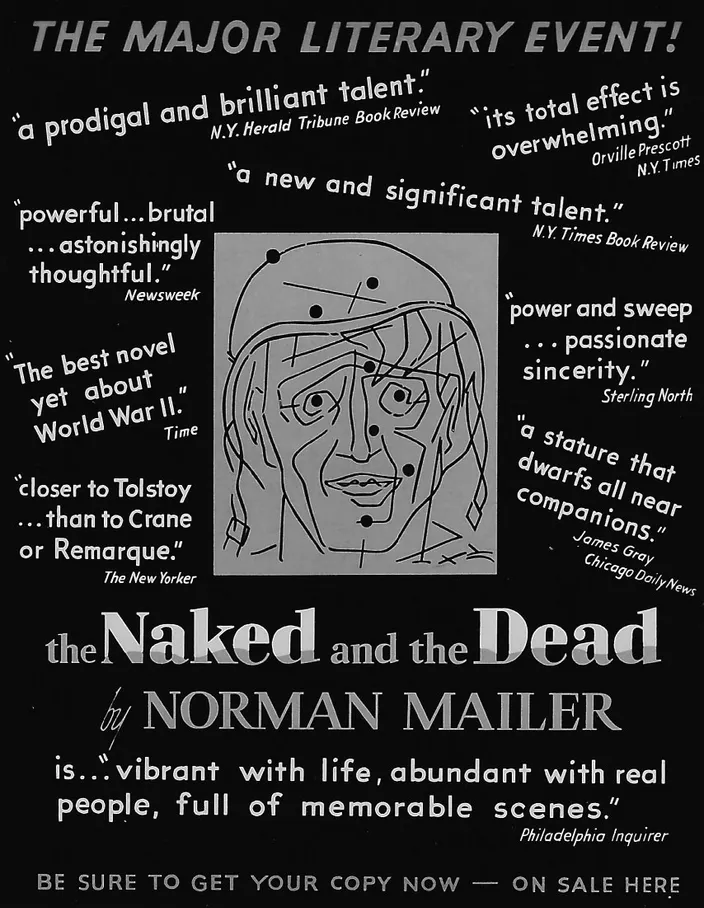
Rinehart ran an extensive NAD campaign through 1948 and 1949. Three representative clippings:
The “Major Literary Event” full-page ad stitches together review quotes from Philadelphia Inquirer, Time, The New Yorker (“closer to Tolstoy than to Crane or Remarque”), and others.
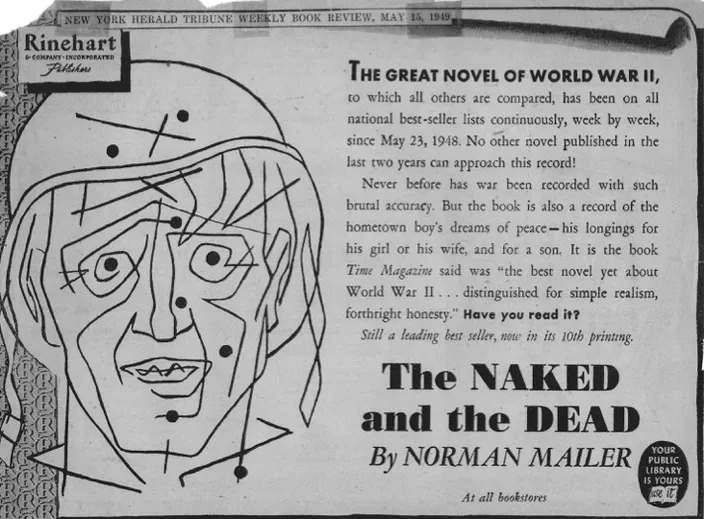
See media/CREDITS.md for each clipping’s provenance and rights note.
Portrait from the NAD year

Mailer at around the time of NAD publication; creator unidentified; see CREDITS.
Origin
Mailer on the conception: “I came out of the Army with an idea for a novel about a long patrol, an idea which had been bound in its origins to a mountain which was to serve as both an actual mass of stone and as a symbolic base for the book. The original conception was allegorical. The mountain was a consciously ambiguous symbol, something too complex, too intangible, to be defined by language” (quoted from 48.4; source: 1941-1948-works.pdf).
Mailer began the book in the summer of 1946 after his discharge from the Army, and finished it fifteen months later.
Reprints and subsequent editions
- Advance excerpt as 48.1 (Cross-Section, March 1948).
- 79.36 — Franklin Library (Franklin Center, Pa., 1979), a signed leather-bound edition with a one-page preface, “A Special Message to Subscribers from Norman Mailer.” To be catalogued separately as a 1979 Work page.
- 98.6 — new Henry Holt edition (1998) with a new introduction. To be catalogued separately as a 1998 Work page.
- 98.7 — partial reprint in The Time of Our Time (1998). See The Time of Our Time.
Mailer’s retrospective commentary on the book appears passim in Advertisements for Myself (59.13) and in The Spooky Art (03.7).
Related pages
- 1948 | "The Naked and the Dead" (advance excerpt) | The Author | Rugged Times | Books I Have Liked
- Rinehart & Company | Beatrice Silverman
- Cross-references from Lennon: 49.3, 65.21, 68.31, 74.18, 74.20, 76.21, 92.12, 95.53 (to be catalogued in their respective years).
- The Naked and the Dead (48.2) | Life-View (48.4) | A Special Message to Subscribers from Norman Mailer (79.36) | Introduction to The Naked and the Dead (98.6) | The Time of Our Time (98.7) | Advertisements for Myself (59.13) | The Spooky Art: Some Thoughts on Writing (03.7)
Referenced by 94
Works
- '48's Nine
- "The Naked and the Dead" (advance excerpt)
- A Calculus at Heaven
- A Hell of a Performance
- A Mysterious Country: The Grace and Fragility of American Democracy
- A Special Message to Subscribers from Norman Mailer
- A Transit to Narcissus
- Barbary Shore
- Books I Have Liked
- Critic At-Large: Mailer's Apology
- Eminent Jews: Bernstein, Brooks, Friedan, Mailer
- Fiction: Revisiting Norman Mailer's The Naked and the Dead
- From Norman Mailer's 'Fug' to Trump's Oval Office
- In Another Place: With and Without My Father, Norman Mailer
- In the Ring with Mailer
- Introduction to The Naked and the Dead
- Life-View
- Love of My Life
- Mailer's Last Days?
- Mailer's Memory
- Making Books: 'Private Ryan' Reviews a Genre
- Mankind in Barbary: The Individual and Society in the Novels of Norman Mailer
- Norman Mailer
- Norman Mailer at 100: Conversations, Correlations, Confrontations
- Norman Mailer: From the Archive
- Norman Mailer: Works and Days (revised edition)
- Norman Mailer's Ripe Garbage
- People Who Read and Write
- Preface to The Joker (My Friend, Jean Malaquais)
- Reply to the Sunday Times on The Naked and the Dead
- Review of Eminent Jews: Bernstein, Brooks, Friedan, Mailer
- Rugged Times
- Talk with Norman Mailer
- The 26 Most American Books of All Time
- The Armies of the Night: History as a Novel, The Novel as History
- The Author
- The Deer Park
- The Making of Norman Mailer
- The Naked and the Dead & Selected Letters 1945–1946
- The Naked and the Read: Inside the Library of Norman Mailer
- The Naked Are Fanatics and the Dead Don't Care
- The Time of Our Time
- The Write Place
- To Mailer, a Good Soldier Puts War on Paper
- War & No Peace
- When in Need of the Right Word, Great Writers Simply Make Them Up
- When Kurt Vonnegut Met Norman Mailer in Cape Cod's Legendary "Helltown"
- Wonder Boy Novelist