1989
The fatwa against Salman Rushdie draws Mailer into a leading public role for free expression: he reads a statement at a 22 February writers' meeting, represents the writers at a March news conference, and joins the international 'Words for Salman Rushdie.' He is more than a thousand pages into Harlot's Ghost, with another advance excerpt appearing in Story. He meets Fidel Castro in Havana, refines his theology in 'Cosmic Ventures,' and offers literary lists — his influences and his ten favorite American novels.
The Rushdie affair
The dominant engagement of Mailer’s year was the Salman Rushdie crisis. After Ayatollah Khomeini’s February fatwa against the author of The Satanic Verses, Mailer read a statement at a 22 February New York meeting of hundreds of writers — published in full as “A Folly Repeated” (89.8), excerpted in USA Today as “We Must Be Willing to Die for Ideas” (89.2). On 3 March he represented the writers, with Robert K. Massie, J. Anthony Lukas, and Letty Cottin Pogrebin, at a news conference seeking common ground with American Muslims (89.3, 89.4), and he joined 27 other writers from 21 countries in the New York Times Book Review’s “Words for Salman Rushdie” (89.5): “we writers who have no faith have been led back to one by your nightmare … your health!”
Harlot’s Ghost, still rising
By early 1989 Mailer was “more than 1,000 pages into Harlot’s Ghost” (89.1) and working, he said, at least 200 days a year. Another advance excerpt, “Harlot’s Ghost: An Excerpt,” appeared in Story in the autumn (89.10) — its prefatory note recalling that winning the Story college contest in 1941 “was one of the most important experiences of my life up to then.”
Letters, lists, and a meditation on God
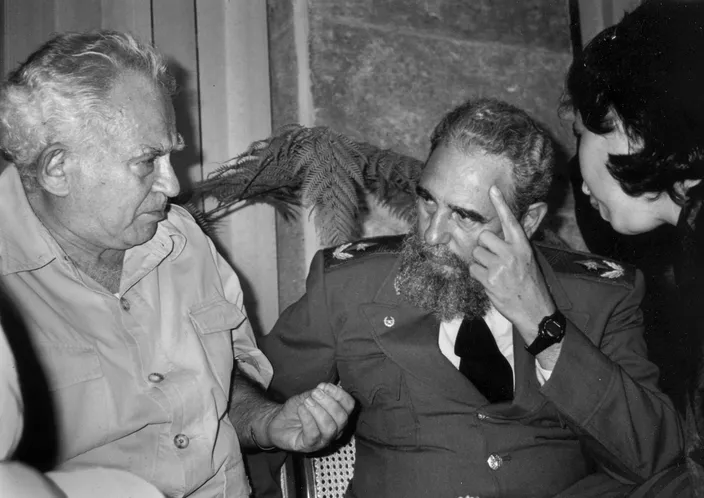
In a year between books Mailer scattered shorter pieces: a tart letter correcting the record on Samuel Goldwyn and The Deer Park (89.6); a Humanist letter updating his 1951 definition of a humanist (89.6a); his list of literary influences for Antaeus (89.5a); and his “Ten Favorite American Novels” for The Reader’s Catalog (89.14). In December Esquire ran “Cosmic Ventures: A Meditation of God at War” (89.11), refining his embattled God. He also wrote the introduction to Luke Breit‘s poetry collection Messages (89.13), and met Fidel Castro in Havana.
Related pages
- 1988 | 1990
- “A Folly Repeated” | Salman Rushdie | “Cosmic Ventures” | “Ten Favorite American Novels”
- Introduction to Messages: New and Selected Poems, 1969–1989 (89.13)