1970
Mailer publishes the third and last of his Life moon installments in January and continues his public commentary on the Chicago Seven trial. In May he serves a brief jail term in Virginia for his 1967 Pentagon conviction, calling Nixon 'the living embodiment of Uriah Heep.' His third experimental film, Maidstone, premieres through the summer and fall - Provincetown, Venice, New York, and London. By year's end the Life moon pieces are gathered as Of a Fire on the Moon (published January 1971), and Mailer separates from Beverly Bentley.
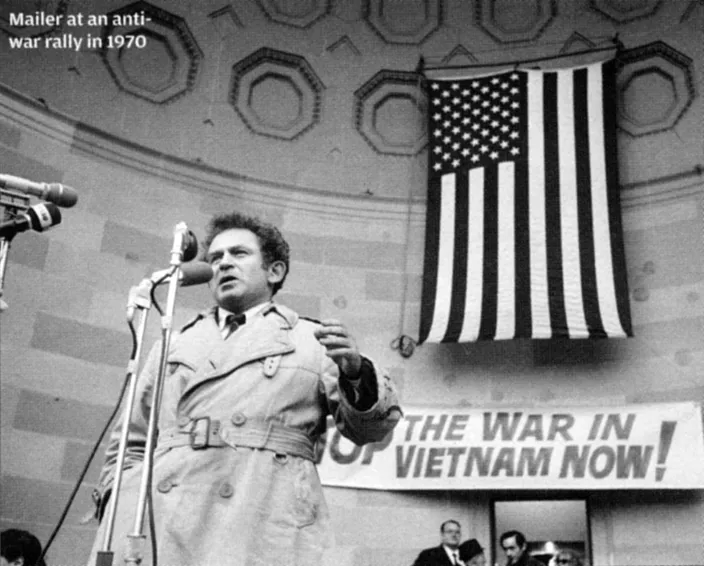
Winter — the moon and the Chicago Seven
9 January — Life publishes “A Dream of the Future’s Face” (70.1), the third and last of Mailer’s three-part series on the 1969 Apollo 11 moon shot — the material that becomes, with much reordering, Of a Fire on the Moon (71.1).
28 January — At a press conference, Mailer comments on his testimony at the trial of the Chicago Seven, the antiwar defendants charged with conspiracy to incite a riot at the 1968 Democratic National Convention. The conference is reported by J. Anthony Lukas in “‘68 Yippie Plans Stunned Mailer” (70.3) — which also describes a Standard Club lunch with Jerry Rubin and Abbie Hoffman — and by Doug Ireland in “Mailer on Chi 7 Judge: ‘A Fast Featherweight’” (70.4).
31 January — An AP wire story, “Mailer Says Piety Dulls Moon Appeal” (70.3a), quotes Mailer’s complaint that NASA “succeeded in making the transcendental event of the 20th century boring.”
Spring
21 February — Opera News runs Charles Matz’s “Mailer’s Opera” (70.2), on the never-completed opera libretto adapting An American Dream, with a cover photograph of Mailer.
March — Mailer’s Chicago Seven testimony is published in The Tales of Hoffman (70.6, Bantam), introduced by Dwight Macdonald. His letter to Writer’s Digest (70.5) complains about the translated Fallaci interview of 1968.
23 April — Visiting the University of Pennsylvania, Mailer calls America “completely schizophrenic,” with two capitals, “the Manned Spacecraft Center in Houston” and “Woodstock” (70.6a).
May — the Pentagon sentence
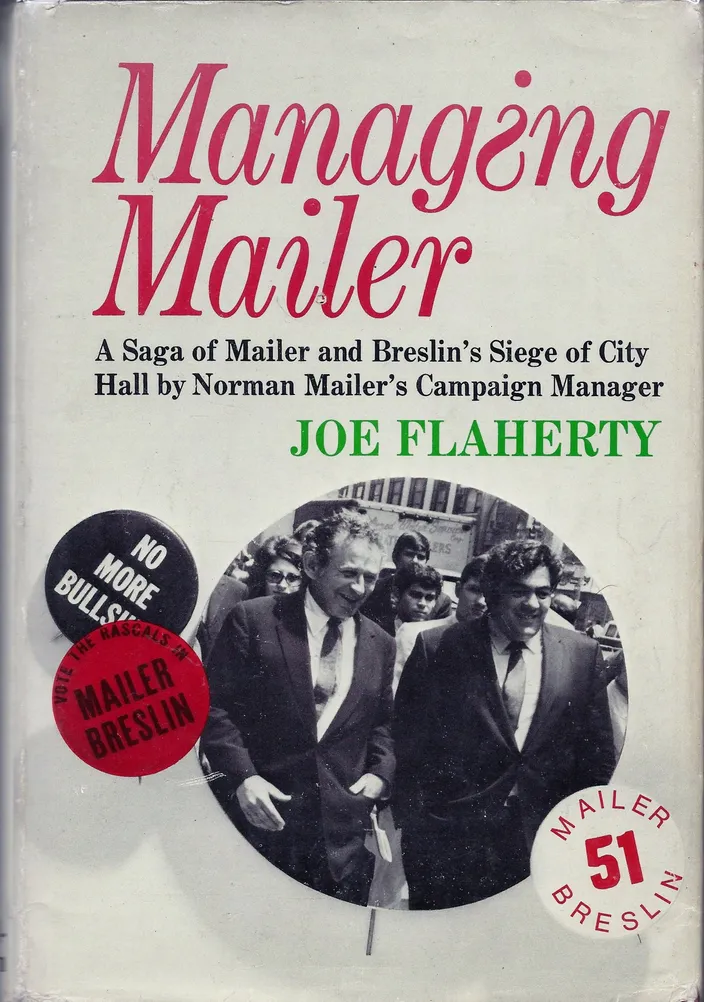
1 May — Coward-McCann publishes Managing Mailer, Joe Flaherty‘s account of the 1969 mayoral campaign, carrying Mailer’s cover-flap statement (70.7).
5–8 May — Mailer serves a brief jail term in the Washington, D.C. area — three days of a thirty-day sentence (twenty-five days suspended) — for crossing a police line at the 22 October 1967 Pentagon demonstration. Turning himself in, he calls President Nixon “the living embodiment of Uriah Heep” and implicates him in the Kent State deaths (70.8, 70.9, 70.10). In his final hours in prison he counsels the antiwar movement toward nonviolence, “because to be violent is to strengthen Nixon’s hand” (70.11).
Summer–fall — Maidstone
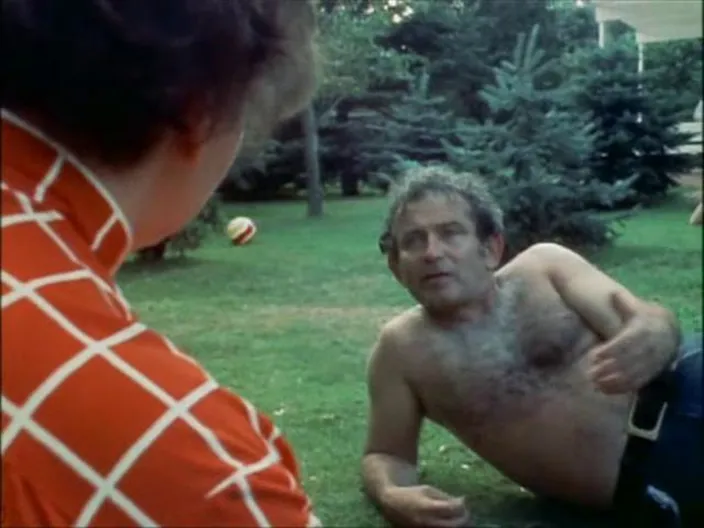
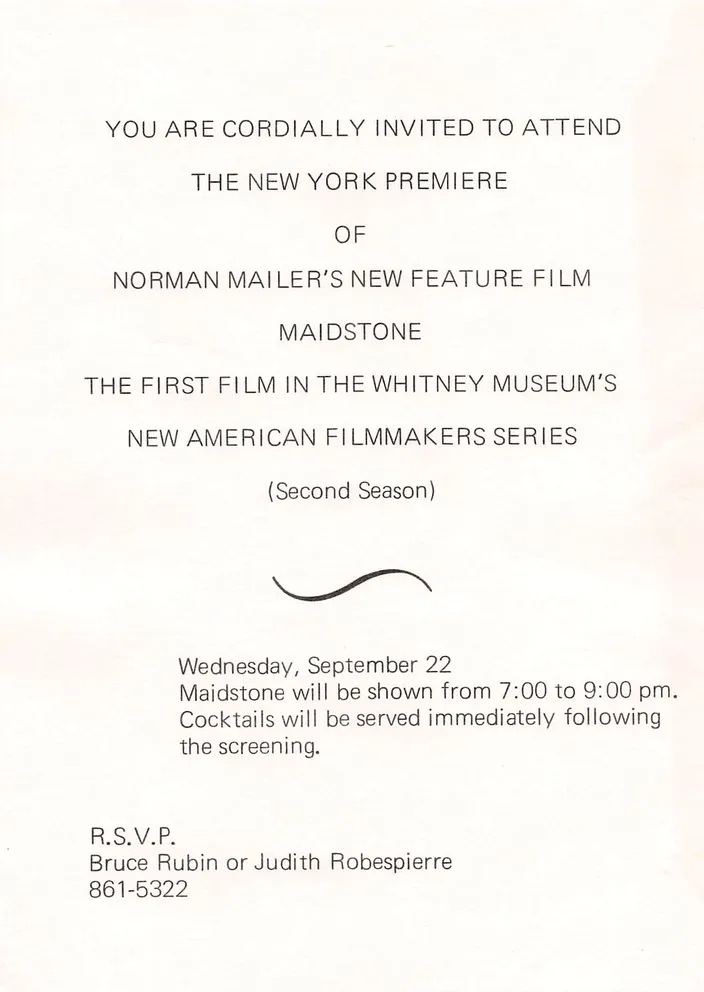
Mailer’s third experimental film, Maidstone, shot in 1968 at East Hampton, premieres through the year. It is first shown in Provincetown on 24 August; Mailer takes it to the Venice Film Festival at the end of August, hoping “to pick up the marbles” (70.12); it has its New York premiere on 22 September as the first film in the Whitney Museum’s New American Filmmakers Series; and it reaches London in October, where Mailer trades jabs with a restless audience after the screening (70.13).
Late September — Mailer’s selection for the anthology This Is My Best — the murder of Deborah from An American Dream — appears with a new prefatory letter calling the novel “my best book” (70.14). Joseph Gelmis’s interview with Mailer on his filmmaking appears in The Film Director as Superstar (70.15, Doubleday).
Fall–winter
7 November — In a letter to Women’s Wear Daily (70.13a), Mailer answers Gore Vidal‘s charge that he was a misogynist, noting that Vidal “was batting .000.”
December — The three Life moon installments are gathered as Of a Fire on the Moon. The book carries a 1970 copyright date, but Lennon dates actual publication to 11 January 1971 (Little, Brown); the 1970 copyright and the 1969–70 advance excerpts created lasting confusion about precedence (71.1). Mailer separates from Beverly Bentley.
Context
The Chicago Seven verdicts come down in February; four students are killed at Kent State on 4 May amid the protests over the Cambodia incursion; the antiwar movement that Mailer joined at the Pentagon remains at the center of national life.
Related pages
- 1969 | 1971
- A Dream of the Future's Face | Testimony at the Trial of the Chicago Seven | The Nonviolent Norman Mailer
- Of a Fire on the Moon | Joe Flaherty | Jerry Rubin | Abbie Hoffman
- '68 Yippie Plans Stunned Mailer (70.3) | Mailer on Chi 7 Judge: 'A Fast Featherweight' (70.4) | Mailer Says Piety Dulls Moon Appeal (70.3a) | Mailer's Opera (70.2) | Letter to the Editor (Writer's Digest) (70.5) | Confrontation with Norman Mailer (70.6a) | Statement for Managing Mailer (70.7) | Mailer Starts Term in Jail, Labels Nixon 'Uriah Heep' (70.8) | Mailer Calls Nixon a Dickens 'Heep' Creep (70.9) | Norman Mailer to Serve Sentence in Alexandria (70.10) | Mailer at Venice with Film Aiming to Be Memorable (70.12) | Mailer, in London, Trades Jabs with Audience over New Film (70.13) | Deborah - from An American Dream (70.14) | Norman Mailer (interview in The Film Director as Superstar) (70.15) | Letter to the Editor (Women's Wear Daily) (70.13a)
Referenced by 21
Works
- '68 Yippie Plans Stunned Mailer
- A Dream of the Future's Face
- Confrontation with Norman Mailer
- Deborah - from An American Dream
- Maidstone: A Mystery
- Mailer at Venice with Film Aiming to Be Memorable
- Mailer Calls Nixon a Dickens 'Heep' Creep
- Mailer on Chi 7 Judge: 'A Fast Featherweight'
- Mailer Says Piety Dulls Moon Appeal
- Mailer Starts Term in Jail, Labels Nixon 'Uriah Heep'
- Mailer, in London, Trades Jabs with Audience over New Film
- Mailer's Opera
- Norman Mailer (interview in The Film Director as Superstar)
- Norman Mailer to Serve Sentence in Alexandria
- Statement for Managing Mailer
- Testimony at the Trial of the Chicago Seven
- The Nonviolent Norman Mailer