An American Dream: Reception and Reviews, 1965
A survey of the contemporaneous critical reception of An American Dream in 1965 — the sharply divided reviews (Wolfe, Hardwick, and Hicks against; Aldridge, Didion, and others for), Mailer's paid reprint of the Aldridge review to 'accompany' Hardwick's, and the best-seller performance. Compiled from the An American Dream Expanded project and Lennon's bibliography.
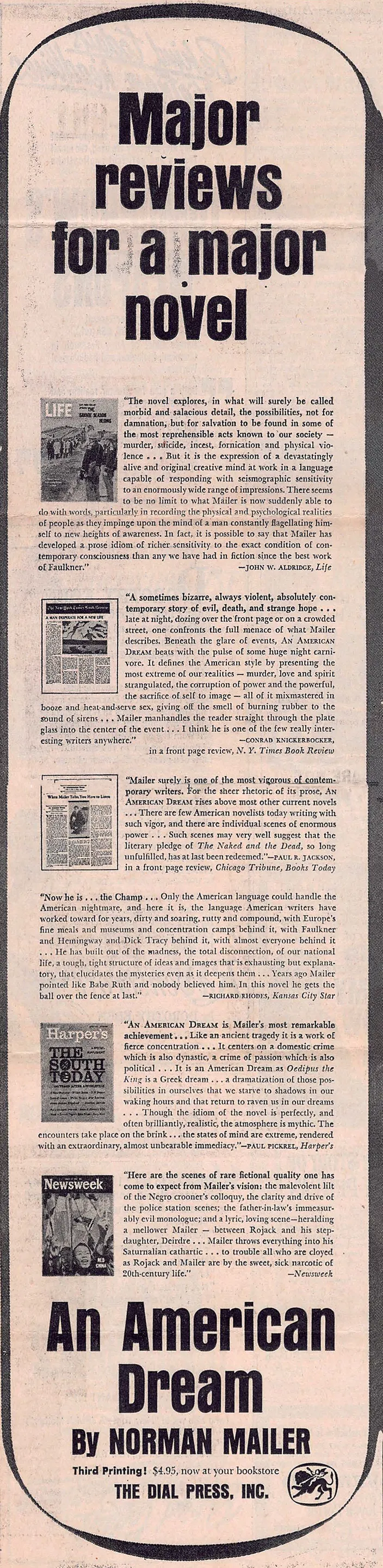
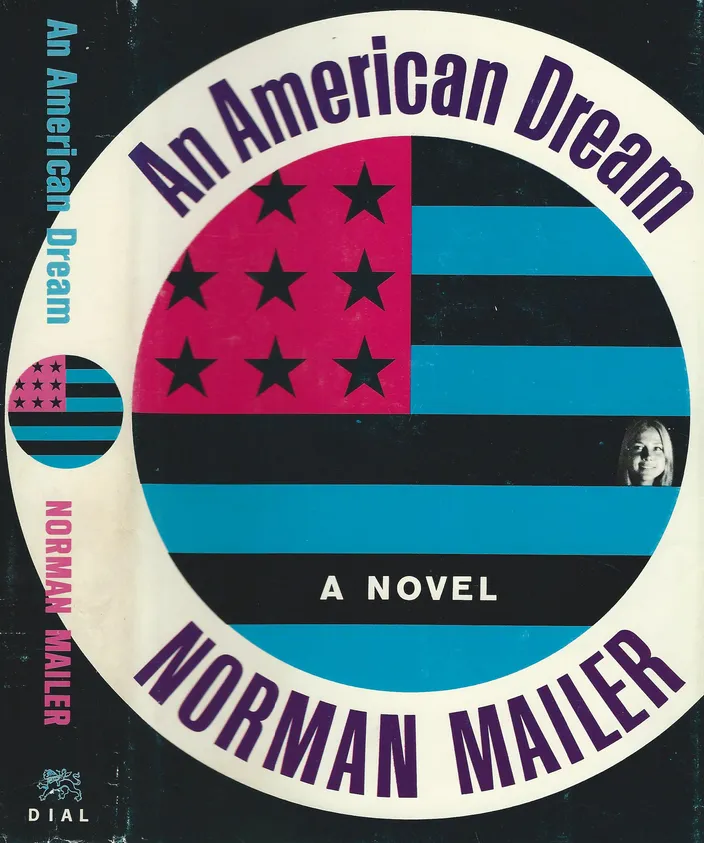
A companion to the Work page for An American Dream (65.7). The novel’s reception in 1965 was among the most polarized of Mailer’s career — a split the publisher leaned into with its “Major Reviews for a Major Novel” advertising.
The divide
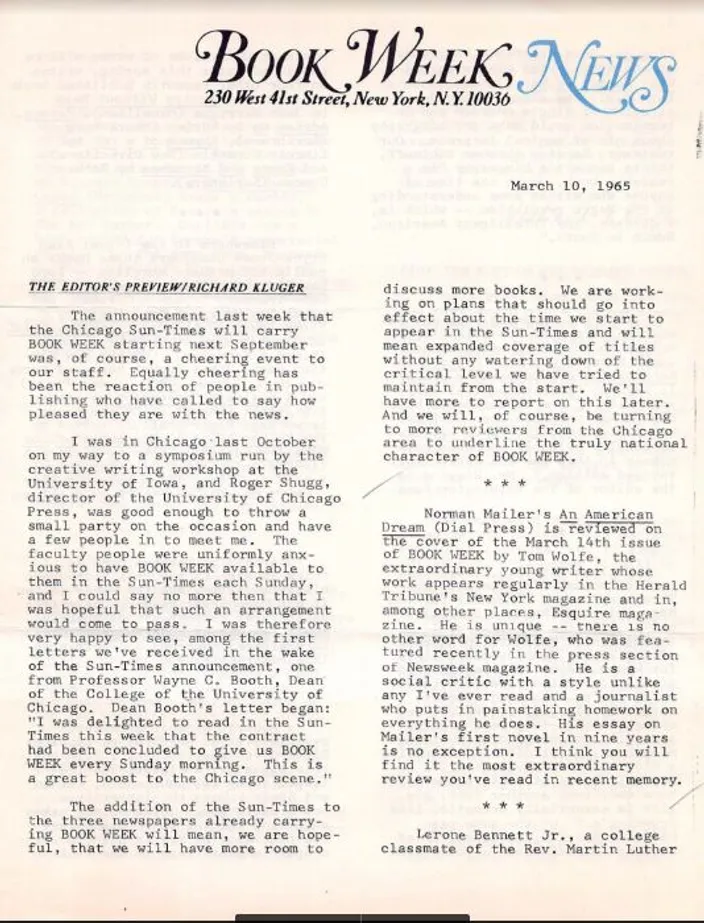
The attacks were prominent and early. Tom Wolfe‘s “Son of Crime and Punishment, or: How to Go Eight Fast Rounds with the Heavyweight Champ and Lose” ran on the cover of Book Week (Washington Post) on 14 March 1965, the day before publication — trailed the previous week by an editor’s notice billing Wolfe as “the extraordinary young writer” and promising readers “the most extraordinary review you’ve read in recent memory.”
 Elizabeth Hardwick‘s “Bad Boy” appeared in Partisan Review. Granville Hicks asked on the cover of the Saturday Review (20 March), “Is Norman Mailer’s New Novel a Literary Hoax?” Stanley Edgar Hyman (“Norman Mailer’s Yummy Rump,” New Leader, 15 March) and Philip Rahv (“Crime without Punishment,” New York Review of Books, 25 March) were likewise hostile.
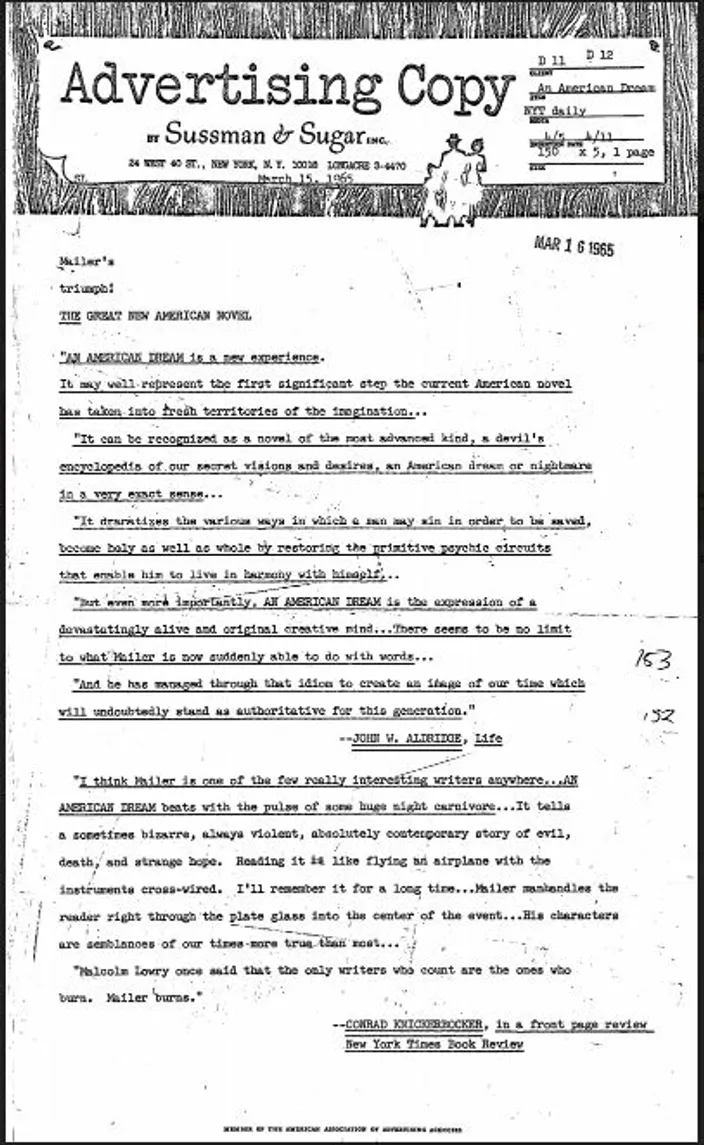
The defenders were equally notable. John W. Aldridge‘s “The Big Comeback of Norman Mailer” (Life, 19 March) called it a triumph; Joan Didion’s “A Social Eye” (National Review, 20 April) admired it; Conrad Knickerbocker (New York Times Book Review, 14 March), Joseph Epstein (“Norman X: The Literary Man’s Cassius Clay,” New Republic, 17 April), and Richard Poirier (“‘Morbid-Mindedness,’” Commentary, June) added serious, mostly favorable readings. British reviews followed the British edition in late April — A. Alvarez (“Norman X,” Spectator, 7 May), Frank Kermode (“Rammel,” New Statesman, 14 May), and the TLS (“In Carcinoma City,” 29 April).
Mailer’s intervention
Mailer fought back in print. In “A Small Public Notice by Norman Mailer” (65.9, Partisan Review, spring), he paid for advertising space to reprint the heart of Aldridge’s positive Life review so that it would “accompany” — and rebut — Hardwick’s negative review in the same issue. He also gave a cluster of pre- and post-publication interviews (65.3, 65.5, 65.11, 65.11a) defending the novel and explaining its single “idea”: “that love is the one human condition we never capture without paying an extraordinary and continuing price.”
The tally and the unusual notices
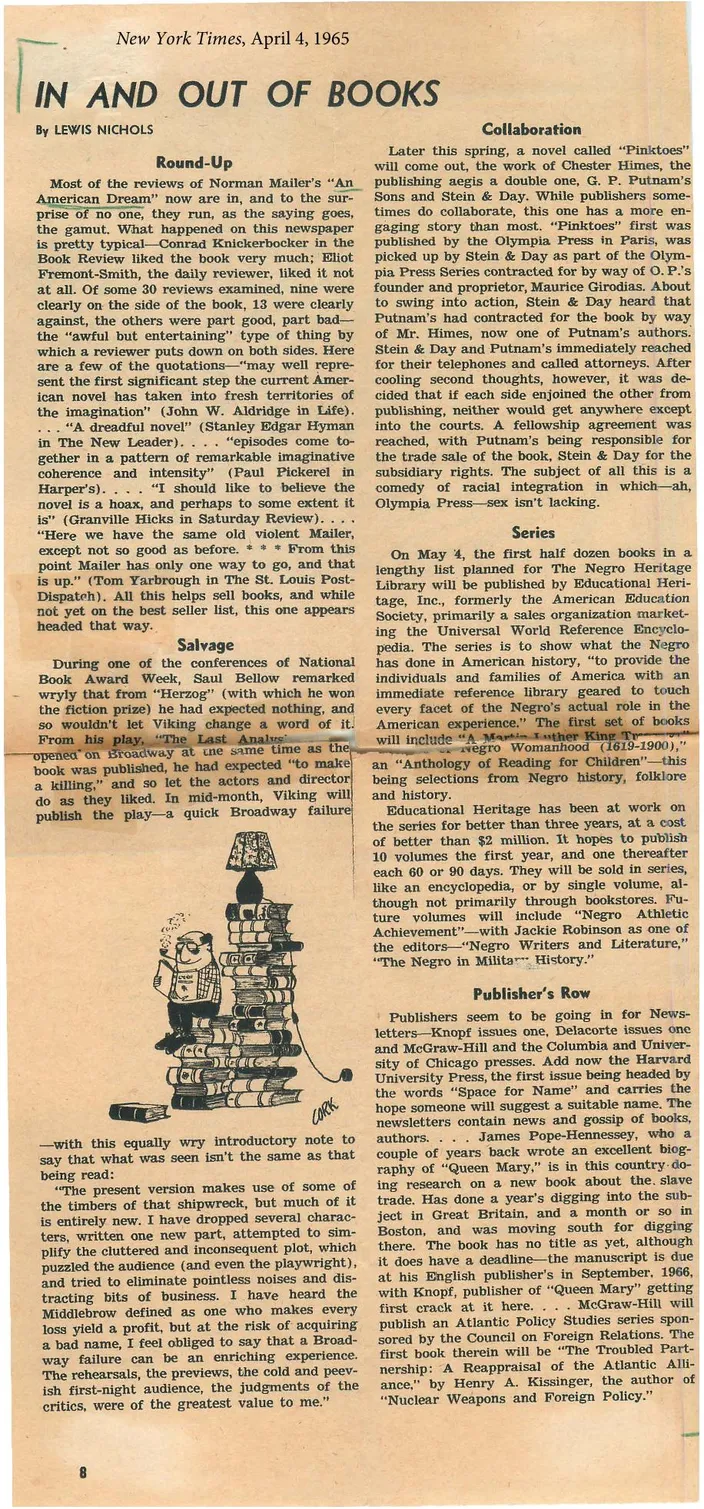
By early April the verdict was, as Lewis Nichols put it in his New York Times “In and Out of Books” round-up (4 April 1965), running “the gamut”: of some thirty reviews he examined, nine were clearly favorable, thirteen clearly against, and the rest mixed — “all this helps sell books, and while not yet on the best seller list, this one appears headed that way.” (Full text held, rights pending, at the round-up.)
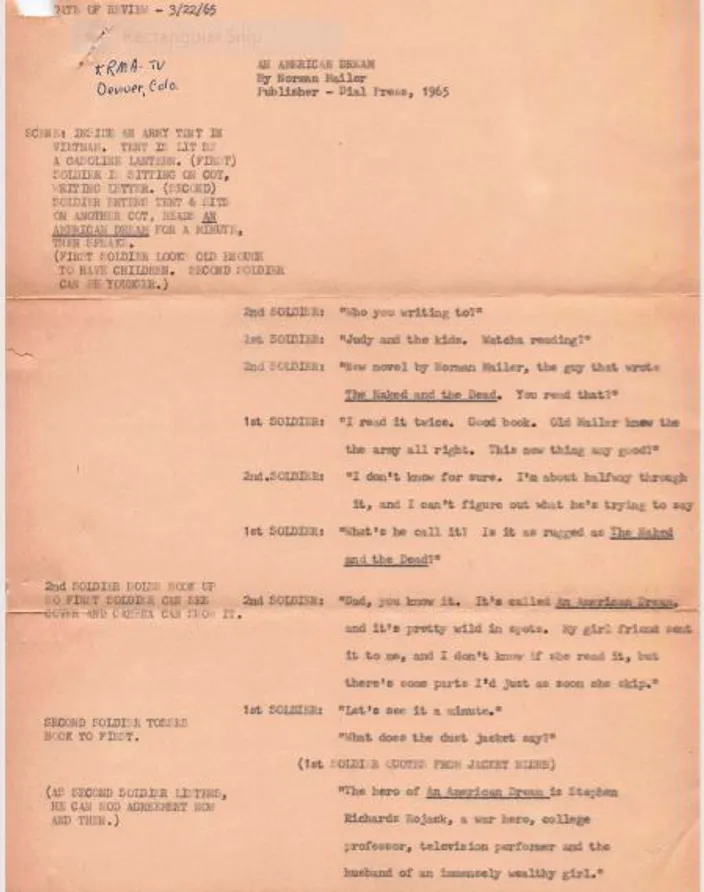
Not every notice was conventional. Donald M. Boucher cast his review (22 March 1965) as a one-act scene — two soldiers in an army tent in Vietnam puzzling over the novel one of them is reading — a dialogue that turns the dust-jacket blurb into theatre and ends with the second soldier, defeated by the book’s meaning, wishing the first “Good Luck, Frank Buck.” (Full text held, rights pending, at the army-tent review.)
Buckley: “There’s Hope in Mailer”
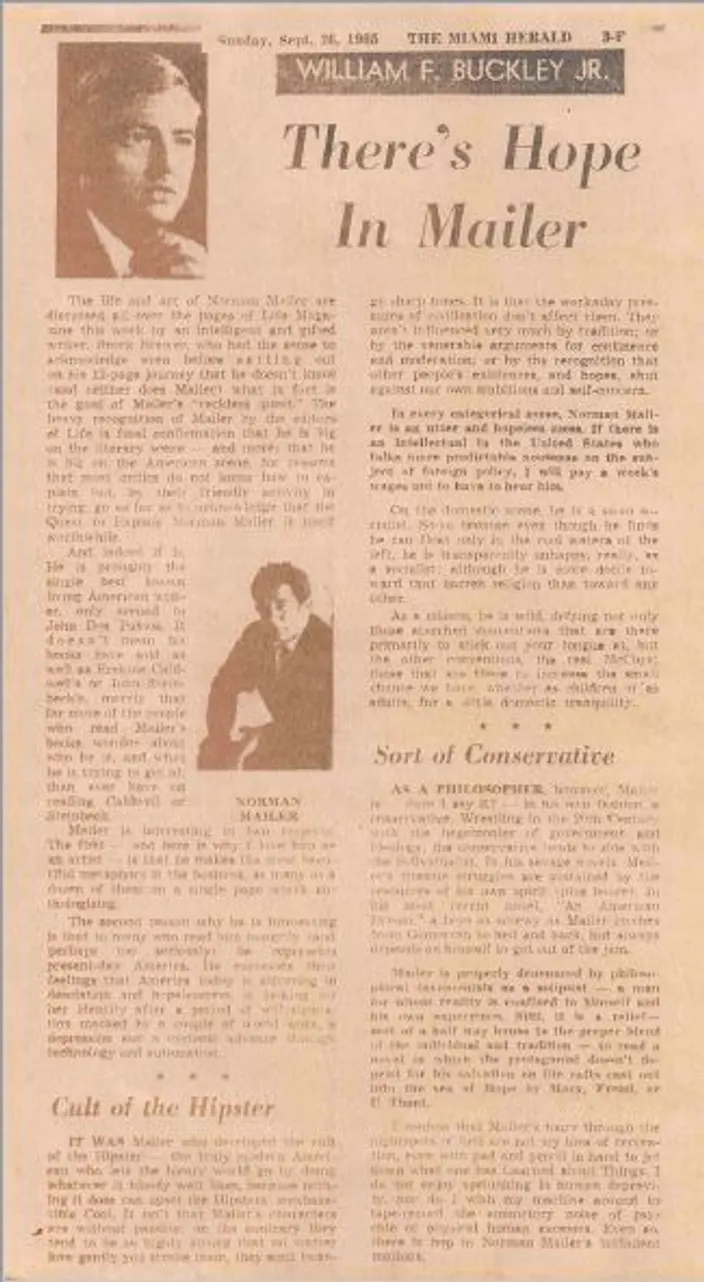
In September, prompted by Brock Brower‘s twelve-page Life profile (65.20), William F. Buckley Jr. devoted a syndicated column, “There’s Hope in Mailer” (Miami Herald, 26 September 1965), to the novelist. Buckley pronounced Mailer “in every categorical sense… an utter and hopeless mess” on foreign policy and “a so-so socialist,” yet found him, “in his own fashion, a conservative” — the rare novelist whose hero “doesn’t depend for his salvation on life rafts coast out into the sea of Hope by Marx, Freud, or U Thant” — and granted that “there is hope in Norman Mailer’s turbulent motions.” (Full text held, rights pending, at the column.)
Commercial performance
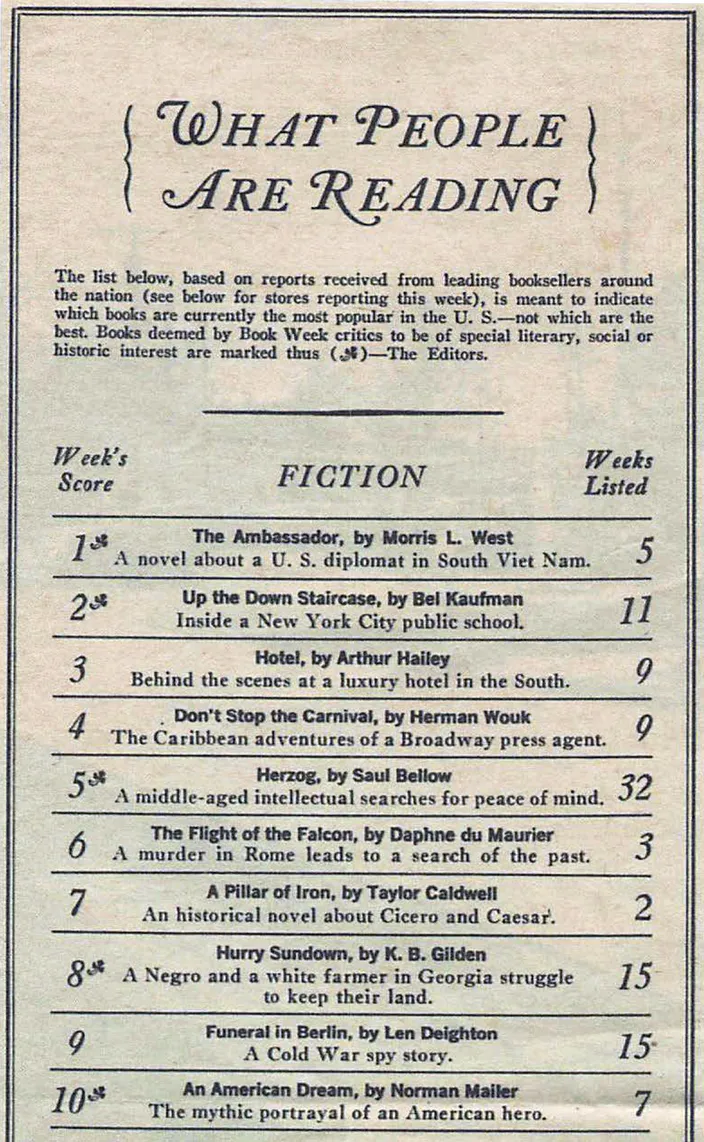
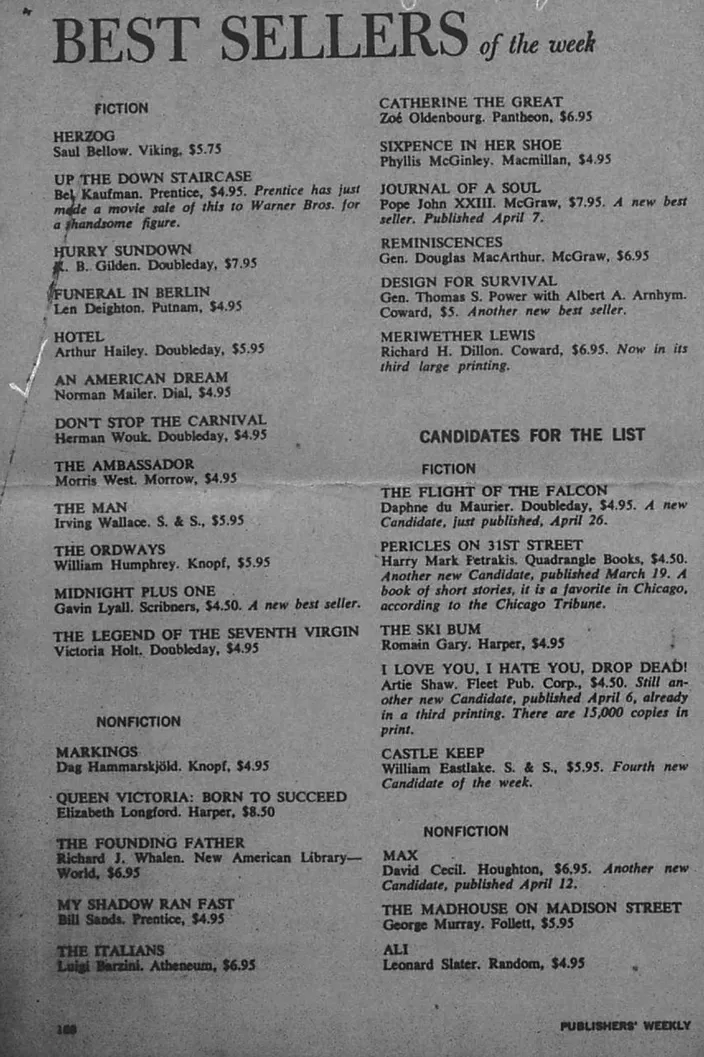
Despite the hostile notices, the novel sold well. It reached No. 4 on the Chicago Daily News list (27 March), No. 3 on the New York Times list (18 April), No. 6 in Publishers Weekly (May), and No. 10 in Book Week (30 May).
Reader letters
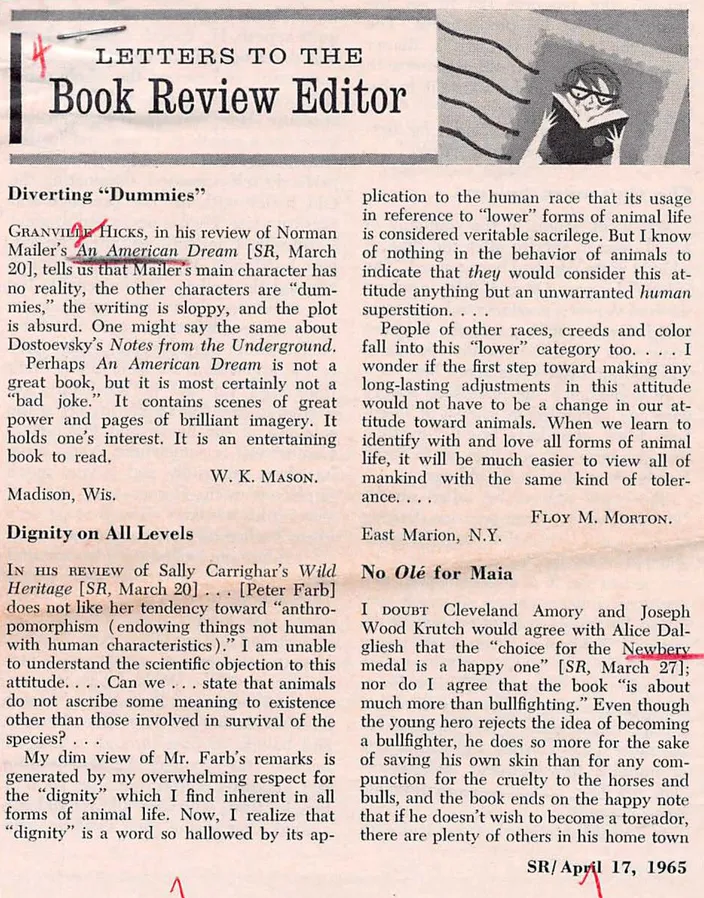
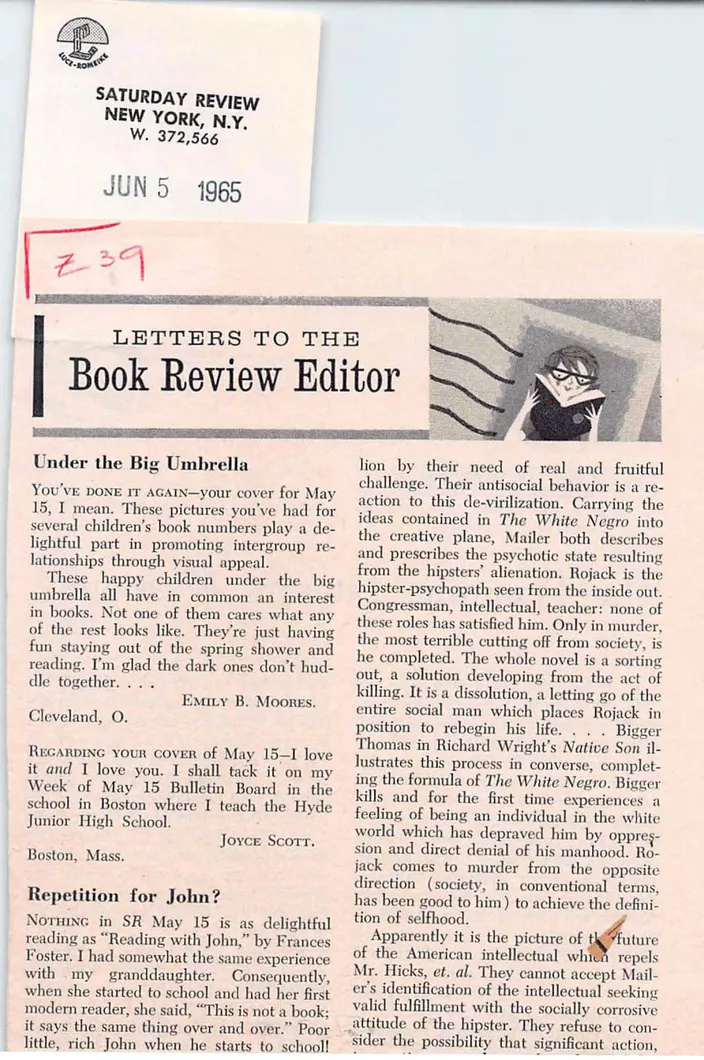
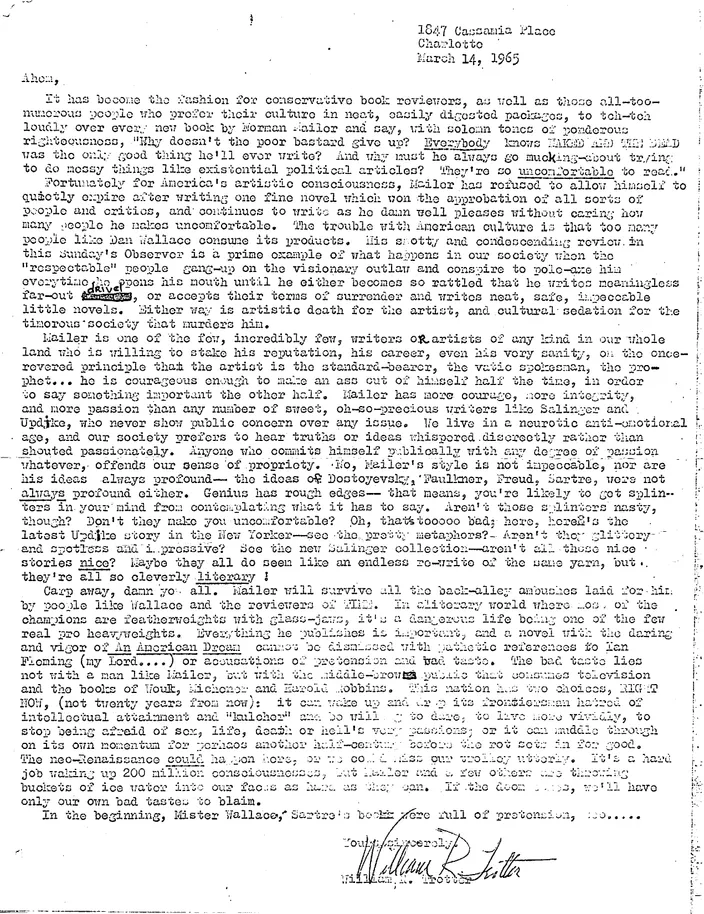
The reviews drew reader responses defending the novel: W. K. Mason wrote to the Saturday Review (17 April) comparing it to Dostoevsky’s Notes from the Underground, and Bill Powers (Saturday Review, 5 June) argued that through murder Rojack places himself “in the position to rebegin his life.” A 1965 letter from William R. Trotter of Charlotte (14 March) and one from Mary Bancroft likewise supported Mailer; Trotter, answering a hostile Charlotte Observer review, cast Mailer as the “visionary outlaw” with “more courage, more integrity, and more passion than any number of sweet, oh-so-precious writers like Salinger and Updike.” (Full text held, rights pending, at Trotter’s letter.)
Related pages
- An American Dream | A Small Public Notice by Norman Mailer
- Tom Wolfe | Elizabeth Hardwick | John W. Aldridge | Brock Brower | William F. Buckley Jr.
- Norman Mailer's "American Dream": Superman Returns (65.3) | In and Out of Books (14 March 1965) (65.5) | Norman Mailer on An American Dream (65.11) | Norman Mailer's Night Out (65.11a) | In This Corner, Norman Mailer: Never the Champion, Always the Challenger (65.20)