An American Dream
Mailer's fourth novel and his first in nine years: the story of Stephen Rojack, who murders his wife and spends 32 hours evading consequence and confronting the Devil. First published as an eight-part Esquire serial (January-August 1964), then heavily revised for the Dial Press first edition (15 March 1965); the British Andre Deutsch edition followed on 26 April. Dedicated to Beverly Bentley, who is pictured on the first-edition dust jacket.
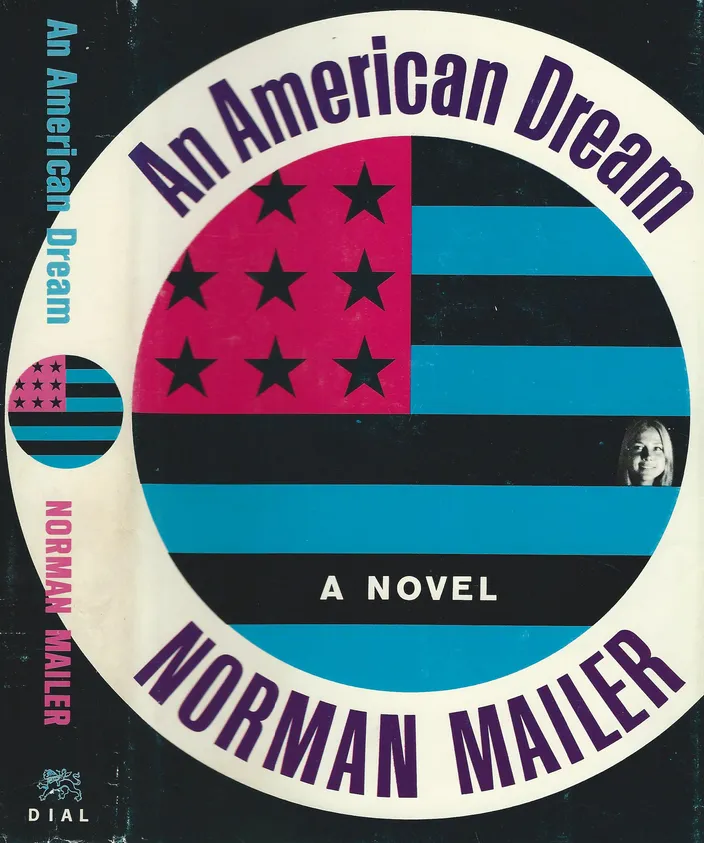
An American Dream (New York: Dial, 15 March 1965; London: Deutsch, 26 April 1965; novel, 270 pp., $4.95) is Mailer’s fourth novel and his first in nine years, after The Deer Park (1955). Its protagonist, Stephen Richards Rojack — war hero, former congressman, professor, and television host — murders his estranged wife Deborah, throws her body from a tenth-floor Manhattan window, and spends the next thirty-two hours in continuous action, evading the police and her father Barney Oswald Kelly, “the solicitor for the devil.” Narrated in Rojack’s “edgy, rococo style,” the novel carries Mailer’s theology of an embattled, limited God locked in struggle with the Devil, and stands as the fullest fictional embodiment of the concerns first worked out in “The White Negro” (57.1).
The dedication reads: “To Beverly and to Michael Burks; an appreciation to Anne Barry, Richard Baron, Walter Minton, Harold Hayes, Donald Fine and not least, Scott Meredith.” Mailer’s fourth wife, Beverly Bentley, is the woman pictured on the dust jacket of the first edition.
Serial origin and revision
The novel was written and published first as an eight-installment serial in Esquire, January–August 1964 (64.2–64.9), each chapter appearing while Mailer was still at work on the next — a method, as the British dust jacket noted, “common enough among the great novelists of the nineteenth century.” Mailer announced the project at the close of the final Big Bite column (63.13, December 1963): “One is tempted to call this novel An American Dream.” Scott Meredith brokered the sale of the unwritten novel to Dial Press and Dell; Esquire editor Harold Hayes agreed to the serial.
Mailer devoted four months in the second half of 1964 to revising the Esquire text for book publication, completing a second revision on the Dial galleys on 20 December 1964. He preferred the book version: “I think the Dial version is the better. The publisher preferred to print the Esquire serial, but I devoted four months to revising it for the book” (Mailer, quoted in Mitgang, New York Times, 10 February 1983). E. L. Doctorow was one of his editors at Dial. The extent and character of the revision — including the renaming of several chapters and the breaking-off of the serial’s conclusion into a separate “Epilogue: The Harbors of the Moon Again” — is detailed on the companion page word-count comparison; Hershel Parker’s Flawed Texts and Verbal Icons (1983) compared the two versions and preferred the Esquire text, a judgment Mailer disputed.
Why Dial, not Putnam’s
Mailer explained to columnist Lewis Nichols (65.5) why the novel went to Dial rather than to his regular publisher, Putnam’s: concerned that the pressure of monthly serialization “might affect its quality,” he reasoned that the book “could be very good, good, bad or very bad indeed, and there would be a lot more pressure on me if I were doing it for a pal” — Walter Minton, Putnam’s president — “Let a stranger” — Richard Baron of Dial — “take a bath.”
Editions and printings
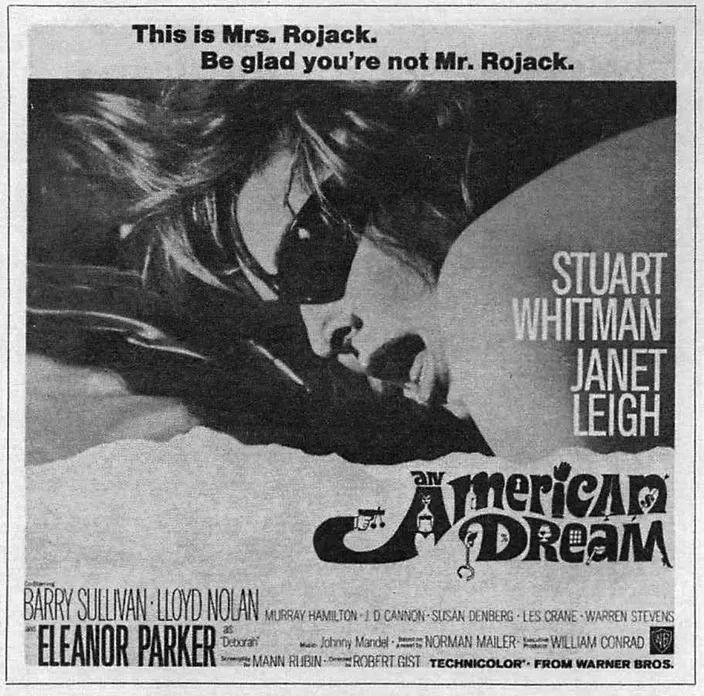
The first U.S. edition was published by Dial Press on 15 March 1965 (270 pp., $4.95); the British first edition followed from André Deutsch on 26 April 1965. The Dell paperback appeared in March 1966; a third Dell printing in February 1970. Later editions include Vintage International, a Chinese-language hardcover, and the Harper Perennial. Warner Brothers purchased the film rights for a reported $200,000 (Mailer to his Japanese translator, 27 January 1965); the film version premiered 26 August 1966.
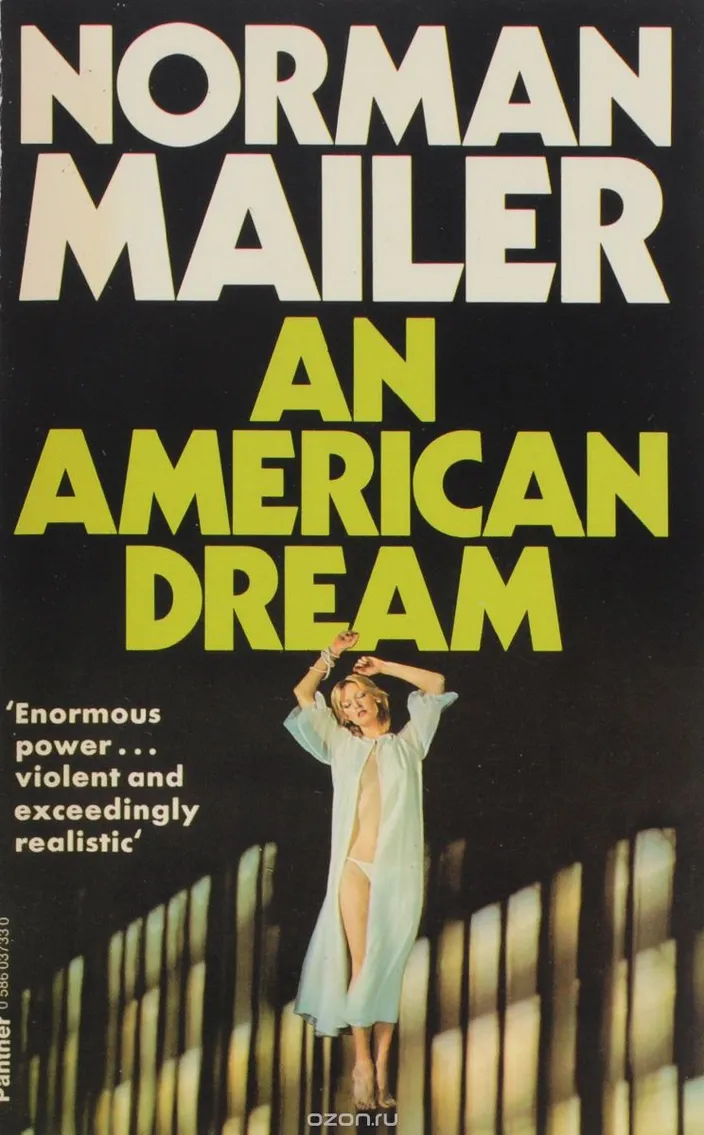
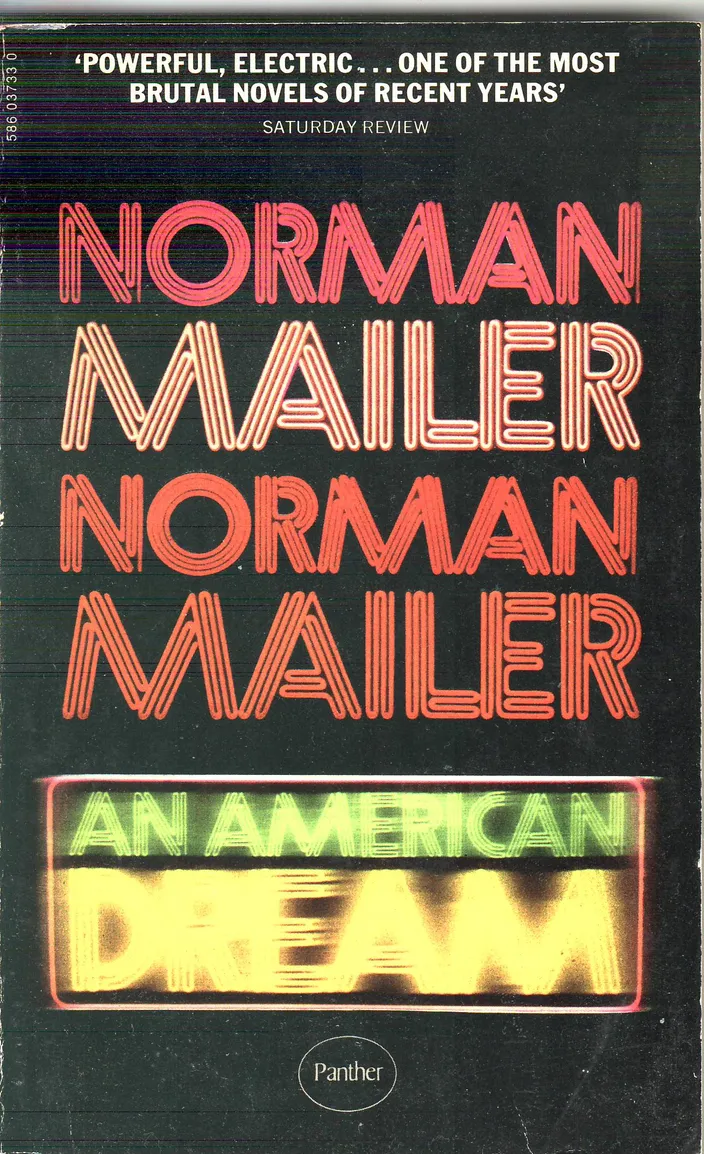
British (Deutsch) jacket
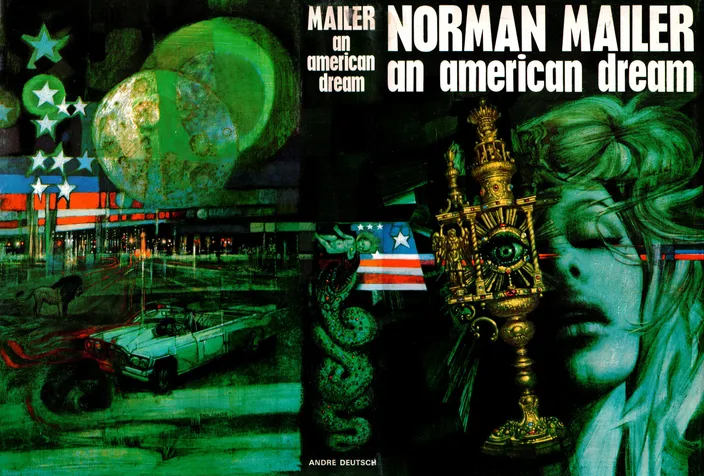
The Deutsch jacket copy framed the novel as Mailer’s “most exciting book since The Naked and the Dead,” emphasizing Rojack as “a man who believes in God and the Devil, and to whom God is courage, not love.”
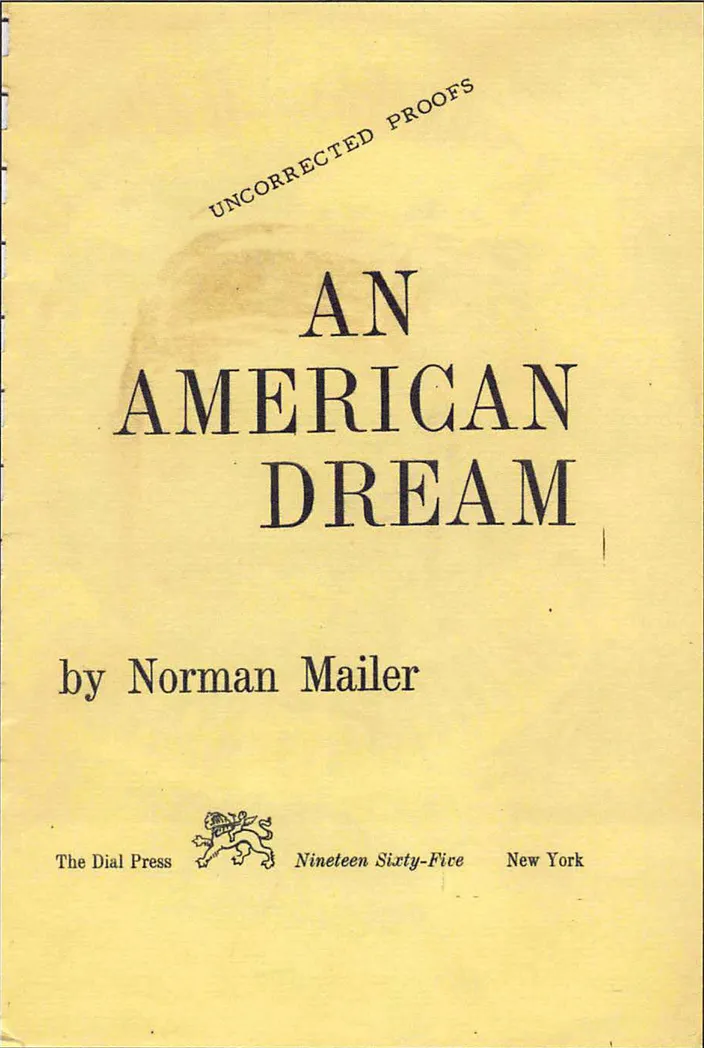
Production artifacts
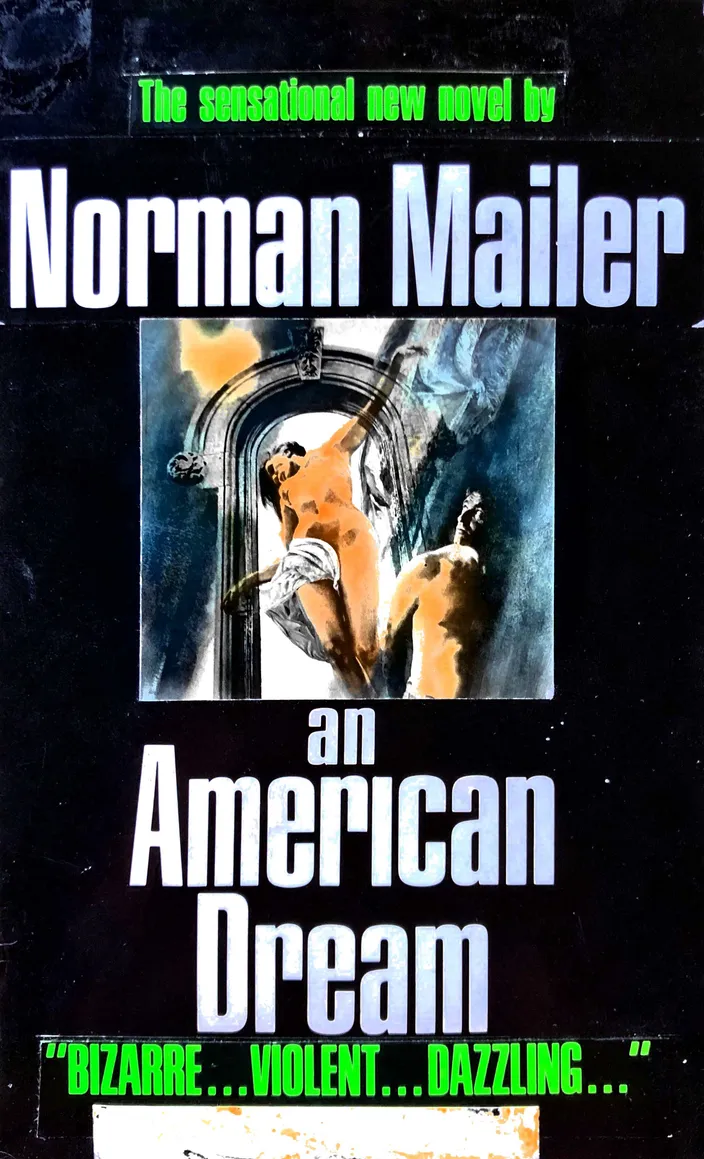
Later editions
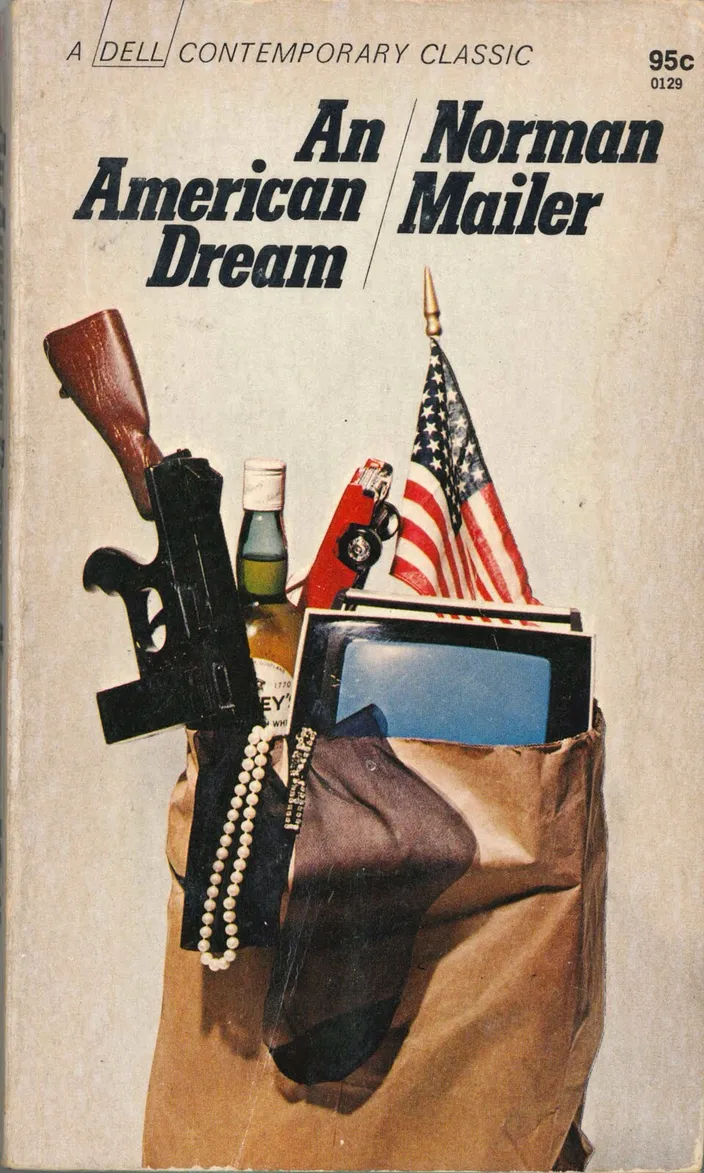
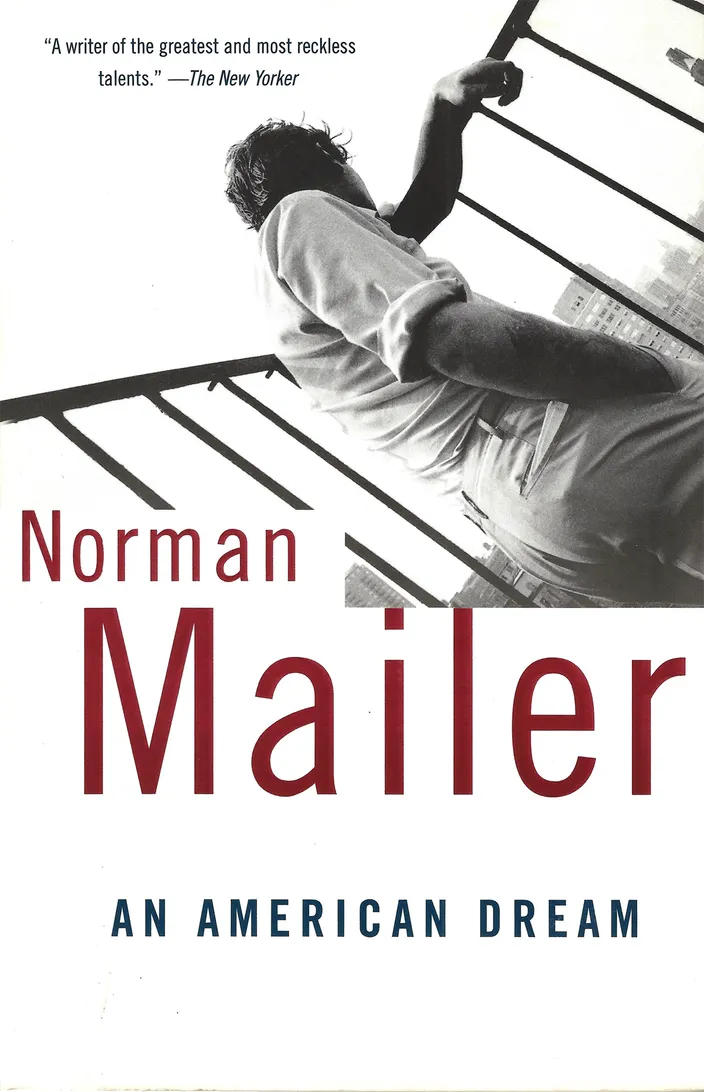
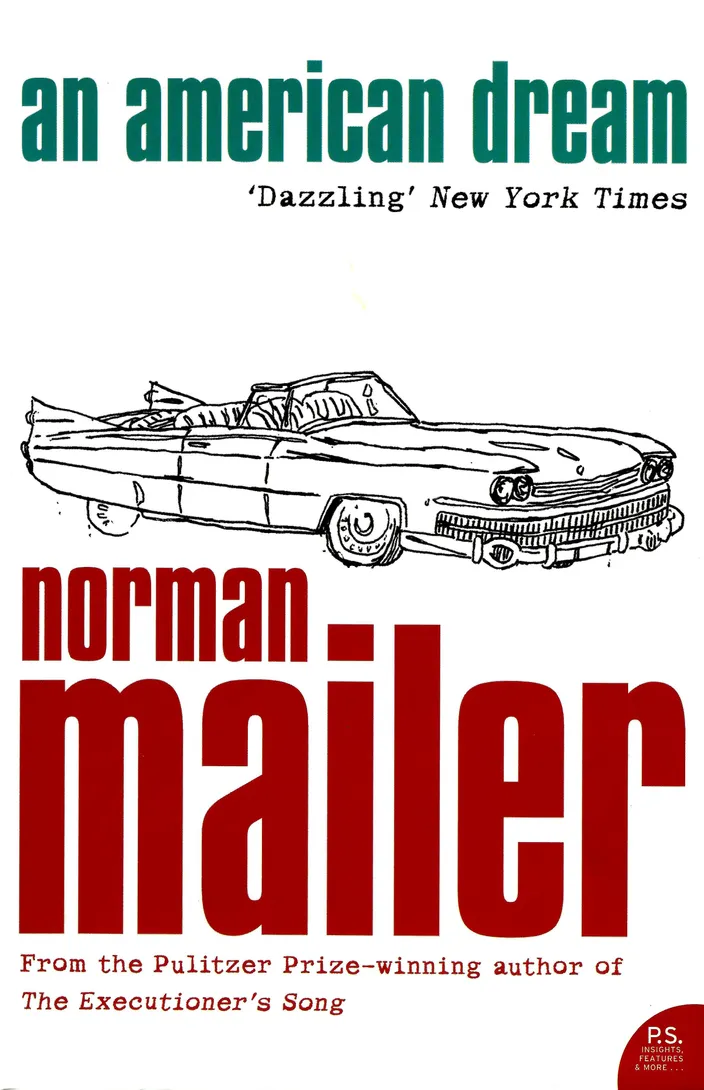

Publication and reception
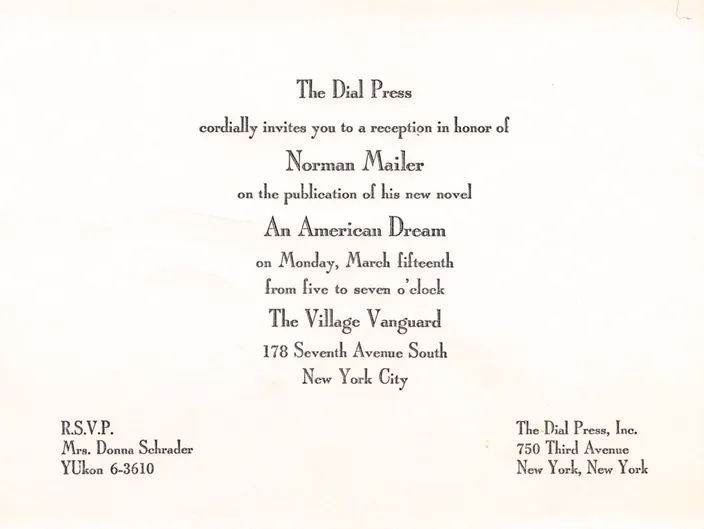
The Dial Press hosted a publication-day reception at the Village Vanguard in New York on 15 March 1965.
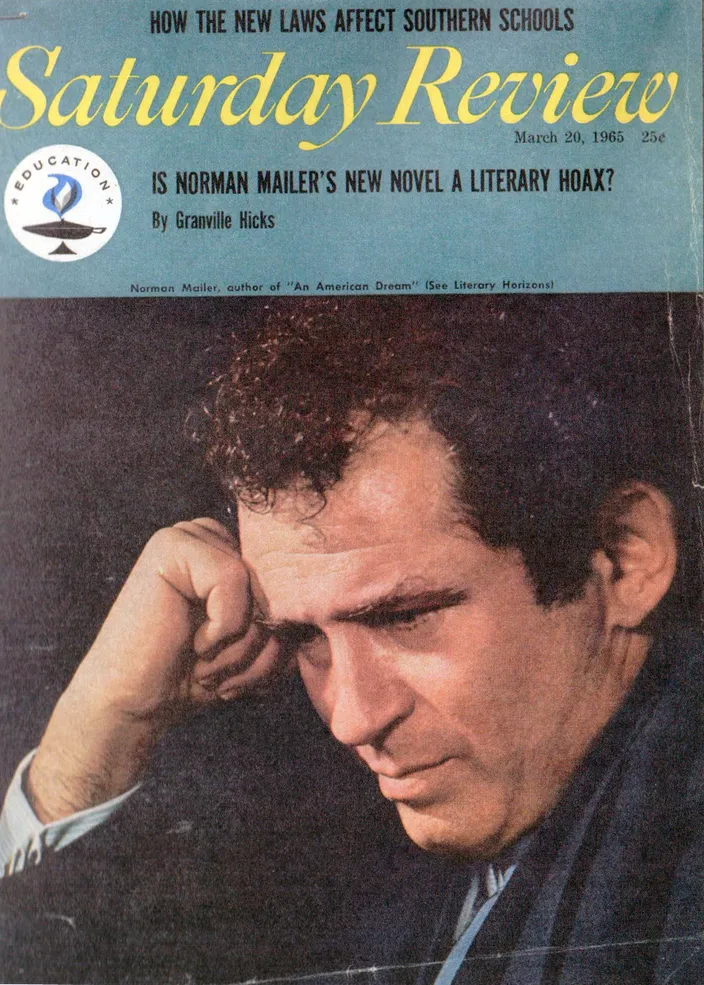
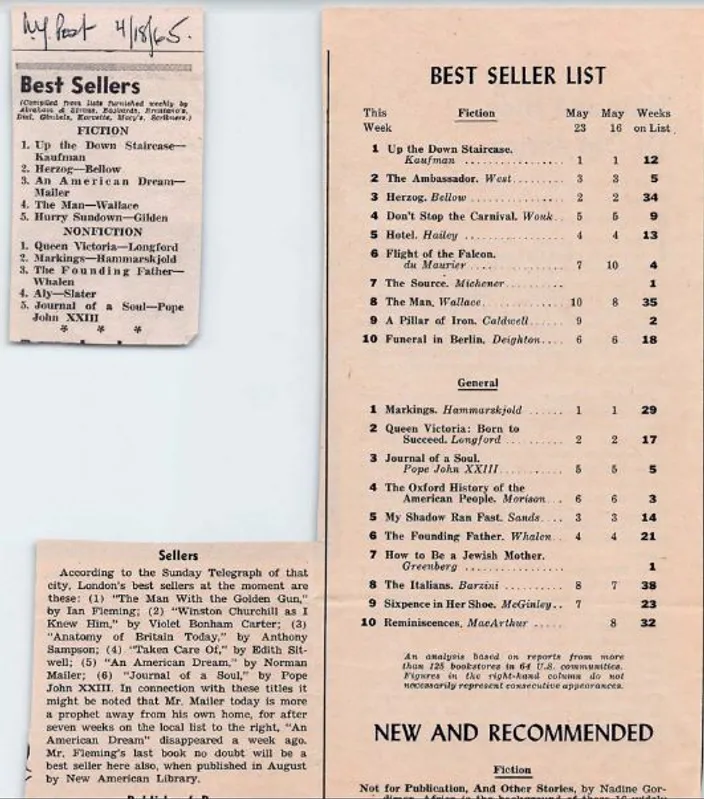
The novel was a commercial success, reaching No. 3 on the New York Times best-seller list (18 April 1965) and appearing on lists into the spring. Critical reception was sharply divided — Tom Wolfe, Elizabeth Hardwick, and Granville Hicks attacked it while John W. Aldridge, Joan Didion, and others defended it. The full reception story, including Mailer’s paid reprint of the Aldridge review (65.9), is gathered on the companion page reception and reviews.
Reprintings
First appeared, in a different form, in Esquire, January–August 1964 (64.2–64.9); partial in The Time of Our Time (98.7).
The Letters on An American Dream
J. Michael Lennon edited Norman Mailer’s Letters on An American Dream, 1963–1969 (Shavertown, PA: Sligo Press, 2004; legacy 04.7), gathering 75 letters that document the novel’s composition, publication, and reception. The collection — digitized as part of the An American Dream Expanded project by Gerald R. Lucas and graduate students at Middle Georgia State University in 2019, from originals supplied by Lennon — will be treated under its own 2004 entry; see the project backlog.
Related pages
- 1965 | Dial Press | André Deutsch | Esquire
- An American Dream: A New Novel Serialized Exclusively in Esquire by Norman Mailer; Installment One: The Harbors of the Moon | Installment VIII: At the Lion and the Serpent | The "Big Bite"
- Word-count comparison: Esquire and Dial editions
- Reception and reviews
- Beverly Bentley | Scott Meredith | Harold Hayes | E. L. Doctorow | Warner Brothers
- The "Big Bite" (63.13) | Norman Mailer's "American Dream": Superman Returns (65.3) | In and Out of Books (14 March 1965) (65.5) | A Small Public Notice by Norman Mailer (65.9) | Norman Mailer on An American Dream (65.11) | Mailer on Chi 7 Judge: 'A Fast Featherweight' (70.4) | Deborah - from An American Dream (70.14) | On the Scholarly Trail of the New Revisionists (83.6)
- The White Negro (57.1) | The Time of Our Time (98.7) | Norman Mailer's Letters on An American Dream, 1963–1969 (04.7)
Referenced by 124
Works
- A Conversation with Mailer
- A Small Public Notice by Norman Mailer
- An American Dream: A Critical Bibliography
- An American Dream: A New Novel Serialized Exclusively in Esquire by Norman Mailer; Installment One: The Harbors of the Moon
- An American Dream: Reception and Reviews, 1965
- An American Dream: Timeline of Events, 1962–1966
- An American Dream: Word-Count Comparison, Esquire and Dial Editions
- Behind the Lines: Dropping His Guard
- Deborah - from An American Dream
- In and Out of Books (14 March 1965)
- Installment Five: A Catenary of Manners
- Installment Four: Green Circles of Exhaustion
- Installment Seven: A Votive is Prepared
- Installment Six: A Vision in the Desert
- Installment Three: A Messenger from the Maniac
- Installment Two: A Messenger from the Casino
- Installment VIII: At the Lion and the Serpent
- Mailer's Opera
- Mankind in Barbary: The Individual and Society in the Novels of Norman Mailer
- Norman Mailer on An American Dream
- Norman Mailer: Four Books of the 1960s
- Norman Mailer's "American Dream": Superman Returns
- Norman Mailer's Letters on An American Dream, 1963–1969
- Norman Mailer's Night Out
- PPA Press Conference
- The "Big Bite"
- The Presidential Papers
- Uncle Norman Makes the Obscene
Letters
- Letter to Adeline Lubell Naiman
- Letter to Alan Earney (15 October 1963)
- Letter to Alan Earney (23 March 1965)
- Letter to Alan Earney (4 November 1963)
- Letter to Andre Deutsch (15 October 1963)
- Letter to Andre Deutsch (16 April 1964)
- Letter to Andre Deutsch (4 November 1963)
- Letter to Andre Deutsch (4 November 1964)
- Letter to Arnold Kemp (18 December 1964)
- Letter to Bill McLaughlin (18 December 1964)
- Letter to Charles Schultz (17 February 1964)
- Letter to David Susskind
- Letter to Diana Athill (21 August 1964)
- Letter to Diana Athill (23 March 1965)
- Letter to Diana Athill (25 February 1965)
- Letter to Diana Athill (5 July 1964)
- Letter to Diana Trilling (14 July 1965)
- Letter to Diana Trilling (25 March 1965)
- Letter to Diana Trilling (6 April 1965)
- Letter to Diana Trilling (8 June 1965)
- Letter to Don Carpenter (1 June 1964)
- Letter to Don Carpenter (15 January 1964)
- Letter to Don Carpenter (25 March 1965)
- Letter to Don Carpenter (5 October 1964)
- Letter to Donald Kaufmann (20 April 1965)
- Letter to Edmund Skellings
- Letter to Eiichi Yamanishi (15 December 1963)
- Letter to Eiichi Yamanishi (16 October 1963)
- Letter to Eiichi Yamanishi (17 January 1964)
- Letter to Eiichi Yamanishi (19 February 1964)
- Letter to Eiichi Yamanishi (26 November 1963)
- Letter to Eiichi Yamanishi (27 January 1965)
- Letter to Eiichi Yamanishi (7 July 1964)
- Letter to Esther Whitby (15 December 1964)
- Letter to Francis Irby Gwaltney (15 May 1964)
- Letter to Francis Irby Gwaltney (20 December 1963)
- Letter to Francis Irby Gwaltney (9 November 1963)
- Letter to George Lea (17 March 1964)
- Letter to Harvey Breit (11 February 1964)
- Letter to Irving J. Weiss (26 August 1965)
- Letter to Jason Epstein (25 March 1965)
- Letter to John A. Meixner (12 June 1965)
- Letter to John W. Aldridge (17 August 1965)
- Letter to John W. Aldridge (23 April 1965)
- Letter to John W. Aldridge (8 June 1965)
- Letter to John William Corrington (8 June 1965)
- Letter to Lionel Abel (28 February 1966)
- Letter to Lonnie L. Wells (16 April 1966)
- Letter to Louis and Moos Mailer (17 April 1964)
- Letter to Louis and Moos Mailer (25 September 1966)
- Letter to Mann Rubin (24 March 1966)
- Letter to Martin Peretz (17 March 1964)
- Letter to Mary Jane Shoultz
- Letter to Mickey Knox
- Letter to Mickey Knox (17 February 1964)
- Letter to Mickey Knox (18 December 1964)
- Letter to Mickey Knox (19 April 1964)
- Letter to Mickey Knox (2 June 1964)
- Letter to Moos Mailer (23 April 1965)
- Letter to Mrs. Jose Casanova (2 June 1964)
- Letter to Nancy Weber (24 September 1966)
- Letter to Pete Hamill (6 July 1964)
- Letter to Reed Whittemore
- Letter to Richard Kluger (22 March 1965)
- Letter to Rita Halle Kleeman
- Letter to Robert F. Lucid (29 September 1964)
- Letter to Roger Shattuck (8 June 1965)
- Letter to Sanford Sternlicht (26 September 1966)
- Letter to Sergio Gutiérrez-Olivos
- Letter to Susan Abrams (24 September 1966)
- Letter to Vahan Gregory (16 March 1964)
- Letter to Vance Bourjaily
- Letter to Virginia Mangrum (21 December 1964)
- Letter to Whit Burnett (1969)
- Letter to Willie Morris
- Letter to Yale M. Udoff (24 September 1966)