Harlot's Ghost
Mailer's vast novel of the CIA, published by Random House on 2 October 1991 — 1,310 pages, his longest book, ending on the words 'TO BE CONTINUED.' Narrated by agent Harry Hubbard across the Cold War from Berlin to the Bay of Pigs, built on his Alpha-Omega theory of personality and the fictional spymaster Hugh 'Harlot' Montague. A national bestseller; the promised sequel, Harlot's Grave, was never written.
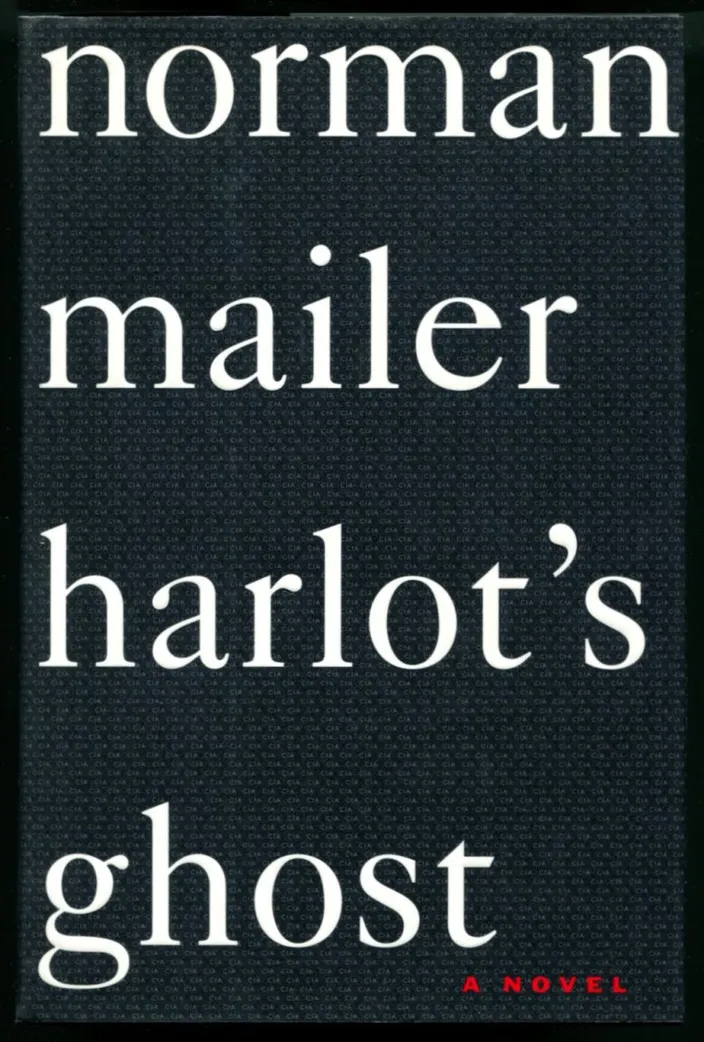
Harlot’s Ghost, Mailer’s novel of the CIA, published by Random House on 2 October 1991 (1,310 pp., $30 — a new high for hardcover fiction; London: Michael Joseph, late October). It is dedicated “To Jason Epstein,” his editor, and ends, after thirteen hundred pages, on the words “TO BE CONTINUED.” It was the largest single project of Mailer’s career to date — pieces of it had been appearing since 1988 — and the most-excerpted of his books: sixteen separate passages are reprinted in The Time of Our Time (98.7).
The novel
Narrated by the CIA officer Harry Hubbard, the novel moves across the Cold War — the bars and brothels of occupied Berlin, the Bay of Pigs, Mongoose-era Miami, Cuba — framed by Hubbard’s marriage to Kittredge and his apprenticeship to the spymaster Hugh “Harlot” Montague. Its architecture has, in Mailer’s phrase, “an excluded middle” — “the missing part shapes up in [the reader’s] mind. Life is like that” (91.41) — and it is organized around Kittredge’s Alpha-Omega theory of the double personality (91.9, 91.23). Mailer had first meant to center the book on the real counterintelligence chief James Jesus Angleton but turned to invention rather than risk misrepresenting a real man (91.12). He framed the CIA as “the nearest thing Americans have to sophisticated evil” and “the interface between bureaucracy and unprecedented action” (91.25, 91.37), and confessed to “loving all that duplicity, deceit, manipulation, double-dealing — all of it — in the name of a higher purpose” (91.26 text). The promised sequel, Harlot’s Grave, was never written.
Reception
The reviews were enormous and divided. Favorable notices came from Anthony Burgess (“A Secret History of Our Time,” Washington Post Book World), Rhoda Koenig (New York), Christopher Hitchens (“On the Imagining of Conspiracy,” London Review of Books), Salman Rushdie (Independent on Sunday), Wilfrid Sheed (New York Review of Books), and the daily New York Times’s Christopher Lehmann-Haupt; against them, Louis Menand (“From Here to Eternity,” New Yorker) and Alfred Kazin (“Mailer’s Romance with the CIA,” Dissent, 1992) were sharply negative, and the former CIA officer E. Howard Hunt weighed in mixed in GQ.
The episode that drew the most ink was Mailer’s feud with John Simon, whose front-page New York Times Book Review notice (“The Company They Keep,” 29 September) was negative. Mailer called Simon “the Adolf Eichmann of theater critics” (91.15), and after meeting the Book Review’s editors won space for a 1,500-word reply, “A Critic with Balance: A Letter from Norman Mailer” (91.48, 17 November), cataloguing Simon’s history of hostile reviews. Later scholarship treats the novel at length (Michael K. Glenday’s Norman Mailer, 1995; Brian J. McDonald’s “Spooks and Agencies” in Norman Mailer’s Later Fictions, 2010; Alex Hicks’s “Harlot’s Anatomy,” The Mailer Review, 2014).
The book reached the bestseller lists nationwide, and on 13 November 1991 Governor Mario Cuomo named Mailer the first New York State Author (with a $10,000 prize; the poet Audre Lorde was named State Poet the same day; 91.44, 91.47).
Related pages
- Jason Epstein | Random House | James Jesus Angleton | John Simon | Christopher Hitchens
- “Children of the Pied Piper” | “How the Wimp Won the War” | “Stormin’ Norman”
- 1991
- The Time of Our Time (98.7) | Harlot's Ghost (91.26)