Why Are We in Vietnam?
Mailer's sixth novel: the obscene, exuberant monologue of D.J., a Dallas teenager, recounting an Alaskan bear hunt on the eve of his shipment to Vietnam. Written in roughly five months (June-November 1966); published by Putnam's on 15 September 1967. The war is named only on the last page, but the novel is Mailer's deepest reckoning with American violence.
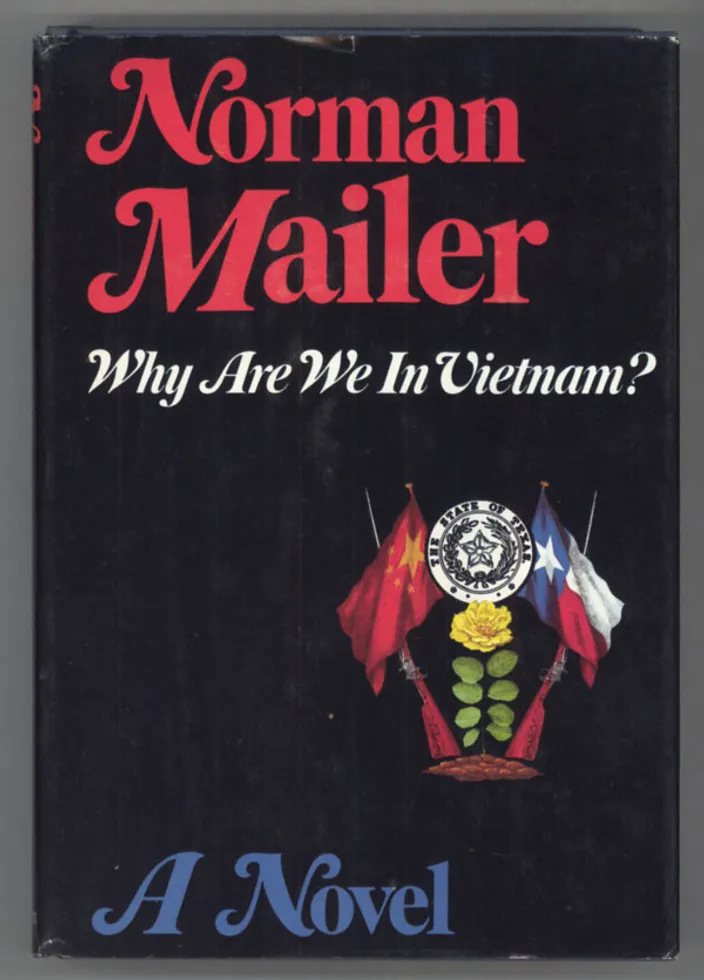
Why Are We in Vietnam? (New York: Putnam’s, 15 September 1967; London: Weidenfeld and Nicolson, 1969; novel, 208 pp., $4.95) is Mailer’s sixth novel — the manic, scatological monologue of “D.J.,” a Dallas teenager broadcasting his consciousness on the eve of being shipped to Vietnam, built around an Alaskan bear hunt taken with his father and his friend Tex Hyde. The war of the title is named only on the final page; the body of the book is an interrogation of the American appetite for violence and domination, “Joyce gone hip,” as Mailer put it, in “a pure American” style. He linked the novel’s roots to “Superman Comes to the Supermarket” and Cannibals and Christians (66.11).
Mailer wrote it fast — “five months, June to November 1966, with a month and a half out to do ‘The Deer Park’ in Provincetown” (67.14). He prized it: “there are times when I decide it’s one of the 10 funniest books written since Huckleberry Finn.”
Composition and form
Why Are We in Vietnam? is one of the few Mailer books not preceded by pre-publication periodical excerpts. Mailer adapted the novel into a one-act sketch, “Why Are We in Vietnam,” staged at least twice — on 19 August 1967 at Act IV in Provincetown, and on 6 December 1971 at an anti-war rally at the Cathedral of St. John the Divine. Under the title “A Fragment from Vietnam: A One-Act Play,” the 13-page sketch appears in Existential Errands (72.7) and The Essential Mailer (82.19). “It’s a book to be read out loud,” Mailer said; “it uses language more for its sound than for what it means” (67.14).
Dedication and the two states
The Putnam’s dedication reads: “To My Friends: Roger Donoghue, Buzz Farber [sic], Mickey Knox, Norman Podhoretz, Cy Rembar and José Torres.” Two states of the Putnam’s first impression exist: one with a tipped-in dedication page misspelling Buzz Farbar‘s name as “Farber,” the other with no dedication page at all. The dedication, correctly spelled, appears in three subsequent softcover editions; the British first edition also lacks one. Lennon judges the dedication page a late afterthought, excised when the spelling error was caught.
Editions
Republished with a new preface by Mailer (New York: Berkley, January 1977, 77.1); the preface is reprinted as “Are We in Vietnam?” in 82.16. Four chapters appear in The Time of Our Time (98.7).
Reception
The reviews were prominent and divided. Eliot Fremont-Smith (“Norman Mailer’s Cherry Pie,” New York Times, 8 September) and Time (“Hot Damn,” 8 September) led; Anatole Broyard (“A Disturbance of the Peace,” NYTBR, 17 September), Granville Hicks (Saturday Review, 16 September), Denis Donoghue (New York Review of Books, 28 September), Eugene Glenn (Village Voice, 28 September), Edmund Fuller (Wall Street Journal, 21 September), and Christopher Lehmann-Haupt (“Norman Mailer as Joycean Punster,” Commonweal, 8 December) followed; John W. Aldridge’s “From Vietnam to Obscenity” (Harper’s, February 1968) is the major retrospective notice.
Related pages
- 1967 | G. P. Putnam's Sons
- Cannibals and Christians | Mr. Mailer Interviews Himself | The Armies of the Night: History as a Novel, The Novel as History
- Roger Donoghue | Buzz Farbar | José Torres
- Norman Mailer on LBJ (65.14) | The Day the Movement Died (72.18)
- Uncle Norman Makes the Obscene (67.14) | Existential Errands (72.7) | The Essential Mailer (82.19) | Preface to Why Are We in Vietnam? (77.1) | The Time of Our Time (98.7)
Referenced by 38
Works
- A Disturbance of the Peace
- A Fragment From Vietnam: A Play in One Act
- A Requiem for the Rube
- An American Dream: Timeline of Events, 1962–1966
- Anything Goes: Taboos in Twilight
- At the 'Filth Barrier' with Norman Mailer
- Existential Errands
- Following the Bouncing Talk of Norman Mailer
- In and Out of Books: Mailer
- Mailer — Man of Fevered Words
- Mr. Mailer Interviews Himself
- Norman Mailer Has Calmed Quite a Bit
- Norman Mailer on LBJ
- Norman Mailer: Four Books of the 1960s
- Norman Mailer's Cherry Pie
- Preface to Why Are We in Vietnam?
- Review of Why Are We in Vietnam?
- The Day the Movement Died
- Uncle Norman Makes the Obscene
- Why Are We in New York?
- Why We Are Interviewing Norman Mailer