The Armies of the Night: History as a Novel, The Novel as History
Mailer's nonfiction narrative of the October 1967 March on the Pentagon, told in the third person as the comic-heroic adventures of 'Mailer.' Published 6 May 1968, twenty years to the day after The Naked and the Dead; winner of the Pulitzer Prize and the National Book Award. A landmark of the New Journalism.
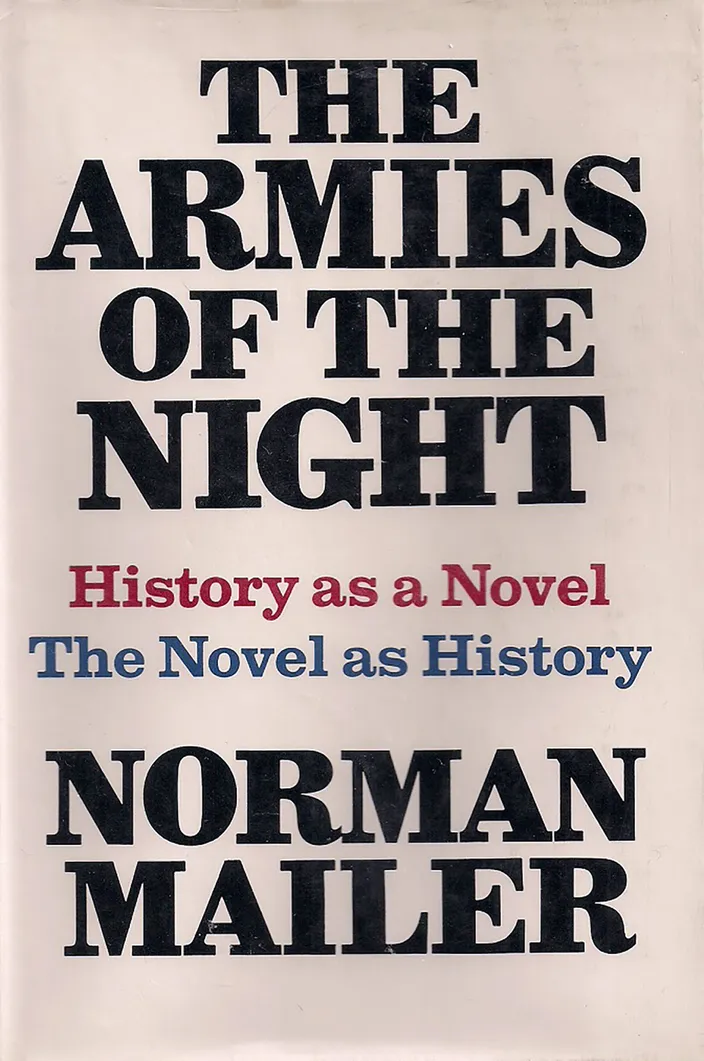
The Armies of the Night: History as a Novel, The Novel as History (New York: New American Library, 6 May 1968; London: Weidenfeld and Nicolson, October 1968; nonfiction narrative, 317 pp., $5.95) is Mailer’s account of the October 1967 March on the Pentagon, in which he took part and was arrested. Its formal daring — narrating Mailer’s own conduct in the third person, as “Mailer,” a comic and self-deflating protagonist, and dividing the book into “History as a Novel” and “The Novel as History” — made it the central text of the New Journalism and the high point of Mailer’s nonfiction.
It was published on 6 May 1968, twenty years to the day after The Naked and the Dead (48.2). The dedication reads: “To Beverly; An acknowledgment to Sandy Charlebois for work beyond the call of duty.” Discarded titles included “Bust at the Pentagon” and “The Armies of the Dead.”
Mailer characterized the book’s tone: “There is no sex [in The Armies of the Night]. In that sense, it’s a nineteenth-century novel. It’s courtly, it’s deliberate, it’s amused with its time and place… I suppose it has the restrained merriment of the early nineteenth-century picaresque novel” (82.16).
Magazine origins
The entire narrative appeared first in two parts: as “The Steps of the Pentagon” (68.2, Harper’s, March 1968 — then the longest article in the magazine’s history and in U.S. journalism to that date) and as “The Battle of the Pentagon” (68.6, Commentary, April 1968). Mailer then revised both for book publication, where they became Book One (“History as a Novel: The Steps of the Pentagon”) and Book Two (“The Novel as History: The Battle of the Pentagon”). For the editor of Harper’s’s own account of the work’s genesis, see Willie Morris, New York Days (1993), 213–22.
Prizes and standing
The Armies of the Night won the Pulitzer Prize for general nonfiction and the National Book Award for arts and letters, and (in 1969) the George Polk Memorial Award for magazine reporting. In 1999 it was ranked nineteenth on New York University’s list of the top 100 works of twentieth-century American journalism. The full reception — the major reviews, the prizes, and the critical afterlife — is gathered on the companion page reception and prizes.
Reprintings
Partial in The Time of Our Time (98.7).
Related pages
- 1968 | New American Library
- The Steps of the Pentagon | The Battle of the Pentagon | reception and prizes
- The Naked and the Dead | Miami and the Siege of Chicago: An Informal History of the Republican and Democratic Conventions of 1968
- When Irish Eyes Are Smiling, It's Norman Mailer (68.26) | Norman Mailer Wins an Award (69.3) | The Book Industry Presents the 20th National Book Awards (69.4) | Mailer the Author Will Donate Prize to Mailer the Politician (69.25) | On Accepting the Pulitzer Prize (69.26) | Mailer Starts Term in Jail, Labels Nixon 'Uriah Heep' (70.8) | The Nonviolent Norman Mailer (70.11) | Existential Errands (72.7) | Letter to John Hohenberg (74.20) | The Executioner's Song (79.14) | Searching for Deliverance (96.5)
- Pieces and Pontifications (82.16) | The Time of Our Time (98.7)
Referenced by 48
Works
- A Hundred Years of Norman Mailer
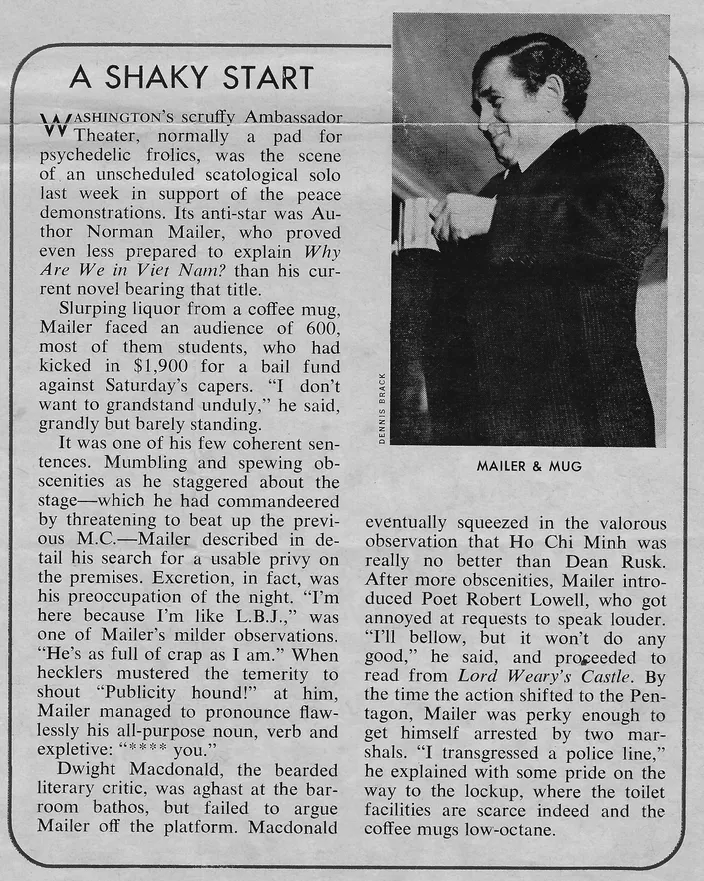
- A Shaky Start
- A Writer's Diary: Mailer Sees Mailer as Book Character for his 'Armies'
- Existential Errands
- In the Ring with Mailer
- Looking for Joan Didion: Norman Mailer's Opposite
- Mailer at Ease
- Mailer Starts Term in Jail, Labels Nixon 'Uriah Heep'
- Miami and the Siege of Chicago: An Informal History of the Republican and Democratic Conventions of 1968
- Mr. Mailer Goes to Washington: The Armies of the Night Fifty Years On
- Norman Mailer in Focus
- Norman Mailer vs. the Big Empty
- Norman Mailer Wins an Award
- Norman Mailer: Four Books of the 1960s
- Norman Mailer: Why I Am Protesting the Presidency
- On Accepting the Pulitzer Prize
- On Vietnam
- Searching for Deliverance
- The Archivist's Apprentice
- The Armies of the Night: Reception and Prizes
- The Battle of the Pentagon
- The Book Industry Presents the 20th National Book Awards
- The Executioner's Song
- The Executioner's Song
- The Nonviolent Norman Mailer
- The Sophomores at Notre Dame
- The Steps of the Pentagon
- We Must All Be Left Conservatives Now
- When Irish Eyes Are Smiling, It's Norman Mailer
- Why Are We in Vietnam?
- Why Norman Mailer Still Matters in 2018