The Executioner's Song
Mailer's 1,056-page 'true life novel' of the Utah murderer Gary Gilmore, built from over 15,000 pages of interviews assembled by Lawrence Schiller; Little, Brown, 15 October 1979. It won the 1979 Playboy fiction award and the 1980 Pulitzer Prize, making Mailer the only writer to win Pulitzers for both fiction and nonfiction. Hub for the year's book-tour coverage.
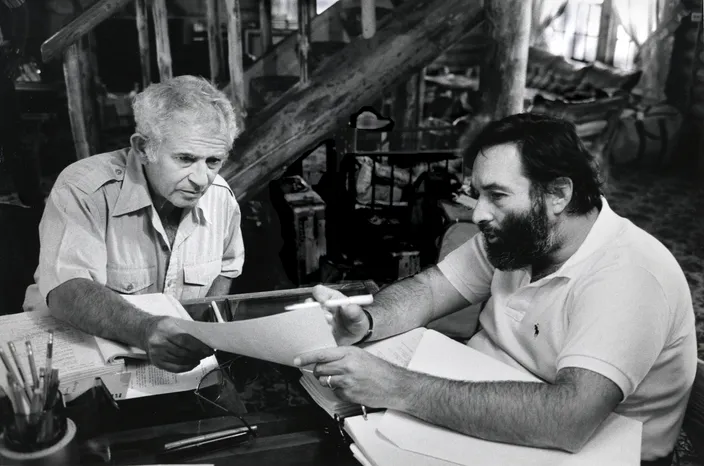
The Executioner’s Song is Mailer’s account of the Utah murderer Gary Gilmore — who killed two men in July 1976 and, refusing to appeal, was executed by firing squad on 17 January 1977 — published by Little, Brown on 15 October 1979 (London: Hutchinson, 5 November). At 1,056 pages it is Mailer’s longest book, built from over 15,000 pages of interviews and court records assembled by Lawrence Schiller, the producer who, Mailer said, engaged his “competitive instinct” — “almost like a line coach.” The dedication reads: “To Norris, to John Buffalo, and to Scott Meredith.” Discarded titles included Violence in America, The Saint and the Psychopath, and American Virtue; the title comes from Mailer’s own 1964 poem (64.18), reused as a chapter title in The Fight (75.12).
Though “scrupulously factual,” the book is subtitled “a true life novel,” and that paradox — Mailer working “as if I’d shifted … into being a photographic realist with found objects,” withdrawing his own voice almost entirely — became the year’s central debate (see 79.17). It is the great turn away from the third-person performer of his earlier nonfiction: the “illeism” of the previous decade gives way to a vast, polyphonic, “collective novel of America.” The narrative ran first, in compressed form, across three Playboy installments (“The Executioner’s Song,” 79.10, 79.19, 79.33), which together won Playboy’s 1979 best-major-work award.
The Executioner’s Song won the Pulitzer Prize for fiction in 1980 — making Mailer the only writer to win Pulitzers for both fiction and nonfiction (the latter for The Armies of the Night, 68.8). Joan Didion’s front-page New York Times Book Review notice called it “an absolutely astonishing book.” Mailer wrote the screenplay for the 1982 NBC adaptation (Tommy Lee Jones, Eli Wallach), nominated for an Emmy. Out of the research came Mailer’s correspondence with the convict Jack Henry Abbott, whom he met that November. Excerpts appear in The Time of Our Time (98.7).
This page is also the hub for the year’s Executioner’s Song book-tour coverage and minor interviews, recorded as bibliography rows for 1979 (79.1, 79.13, 79.13a, 79.13b, 79.14a, 79.15–79.18, 79.20a, 79.22–79.25, 79.27–79.29, 79.31, 79.34).
Related pages
- Gary Gilmore | Lawrence Schiller | Jack Henry Abbott | Illeism (the third-person self)
- Playboy serial: “Part I” (79.10), “Part II” (79.19), “Part III” (79.33)
- Major interviews: Bragg (79.26), Buckley/Firing Line (79.32)
- 1979
- The Armies of the Night: History as a Novel, The Novel as History (68.8) | Until Dead: Thoughts on Capital Punishment (81.5) | How Novels Get Titles (82.22) | "Comments" (in Shot in the Heart) (94.3)
- The Executioner's Song (64.18) | The Fight (75.12) | The Time of Our Time (98.7)
Referenced by 40
Works
- A Murderer's Tale: Norman Mailer Talking to Melvyn Bragg
- An Interview with Norman Mailer (Aldridge)
- Browsing Through Mailer's 'Cannibals'
- Crime and Punishment: Gary Gilmore
- Desert Island Discs: Norman Mailer
- Do Facts and Fiction Mix?
- Introduction to In the Belly of the Beast
- Looking for Joan Didion: Norman Mailer's Opposite
- Mailer Book Was the 2nd Choice of Fiction Advisory Panel
- Mailer on Gilmore
- Mailer Wins Pulitzer for Gilmore Story
- Mailer's Real-Life Escapades Outdo Fiction
- Norman Mailer: Warrior in the Battle of the Sexes
- PW Interviews: Norman Mailer
- Talking with Mailer
- The Armies of the Night: History as a Novel, The Novel as History
- The Executioner's Song
- The Executioner's Song (Playboy, Part I)
- The Executioner's Song (Playboy, Part II)
- The Executioner's Song (Playboy, Part III)
- Throwing Punches: Mailer on Mailer
- Until Dead: Thoughts on Capital Punishment