1983
Mailer turns sixty and publishes Ancient Evenings, the Egyptian novel eleven years in the writing, on 4 April - to his 'best and worst reviews' and a months-long promotional tour. In February-March he serves as the University of Pennsylvania's first Pappas Fellow, lecturing on 'The White Negro Reconsidered.' In August he leaves Little, Brown for Random House on a $4 million contract, with Jason Epstein as his new editor; in October he buys the house at 627 Commercial Street that becomes his year-round Provincetown home. He is nominated for an Emmy for the Executioner's Song screenplay.
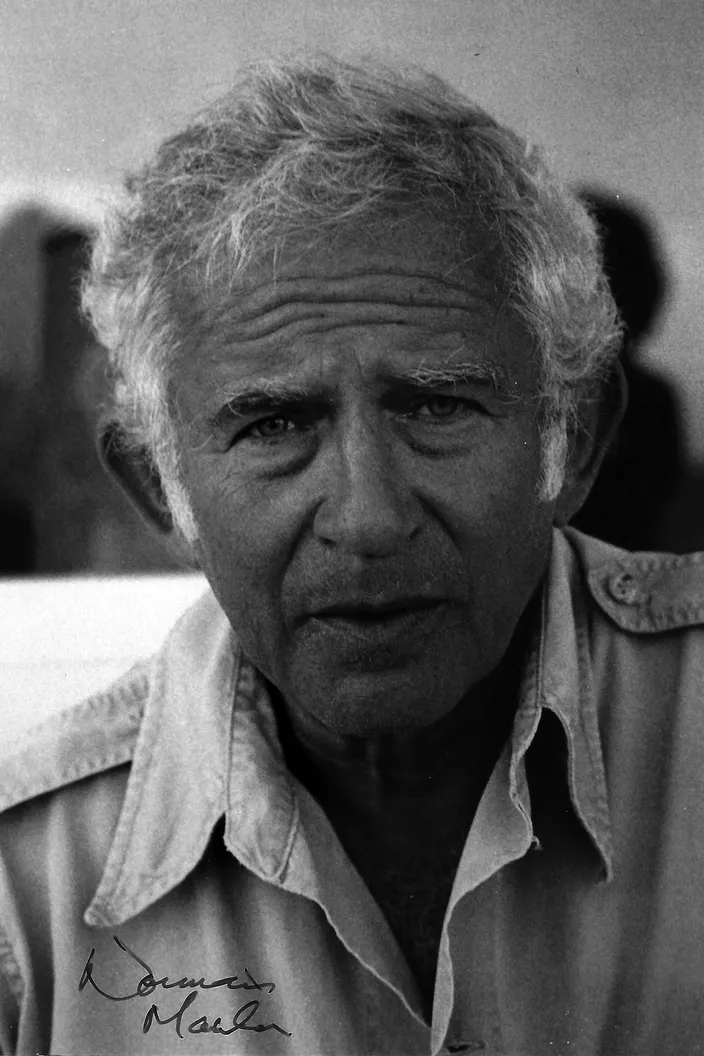
Winter — turning sixty, and the long approach to Egypt
Mailer turned sixty on 31 January. The winter’s publicity built toward Ancient Evenings (83.18): a 28 January luncheon at New York’s Lotos Club with out-of-town book editors produced a cluster of “Mailer at 60” interviews (83.2–83.7), and in March Robert Begiebing‘s “Twelfth Round” interview appeared in Harvard Magazine (83.10) — one of the most important he ever gave. Marie Brenner’s New York portrait “Mailer Goes Egyptian” (83.13) caught him on the eve of publication. In March the first staged reading of “Strawhead,” his play drawn from Of Women and Their Elegance, was given at Boston’s Loeb Drama Center (83.11).
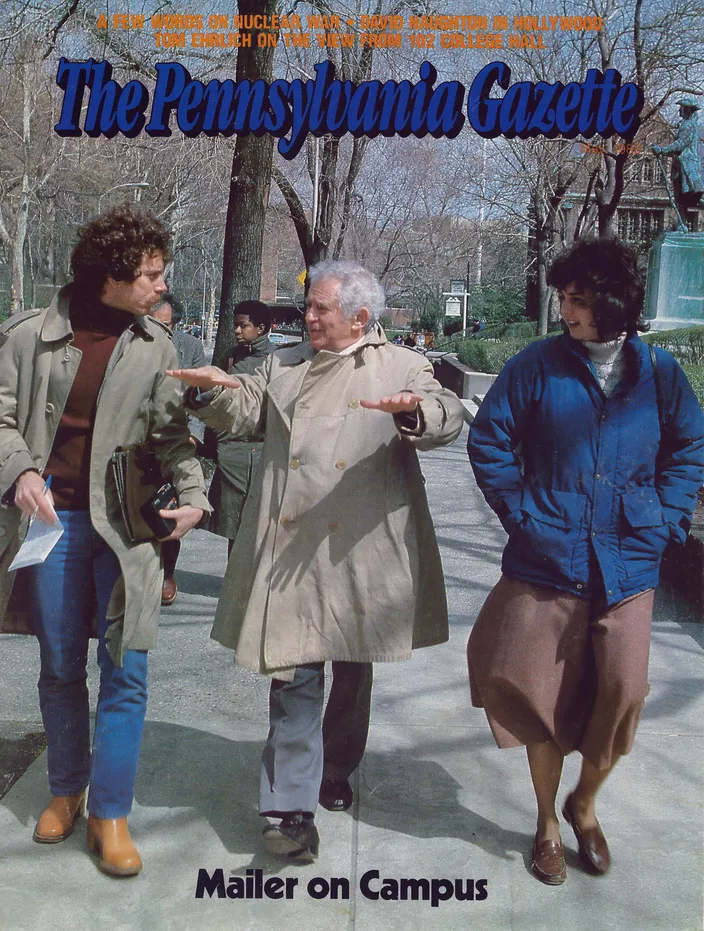
February–March — the Pappas Fellow at Penn
Mailer spent a week as the University of Pennsylvania’s first Pappas Fellow, a visit organized by his friend and the Penn English chairman Robert F. Lucid. The centerpiece was a lecture, “The White Negro Reconsidered,” followed by a sharp exchange with Black students; he also lectured on journalism and on nuclear war. The week is gathered on “The Surreal Professor” (83.35), the fullest account, with 83.12 and 83.14–83.16, 83.21, and 83.37 as supporting coverage.
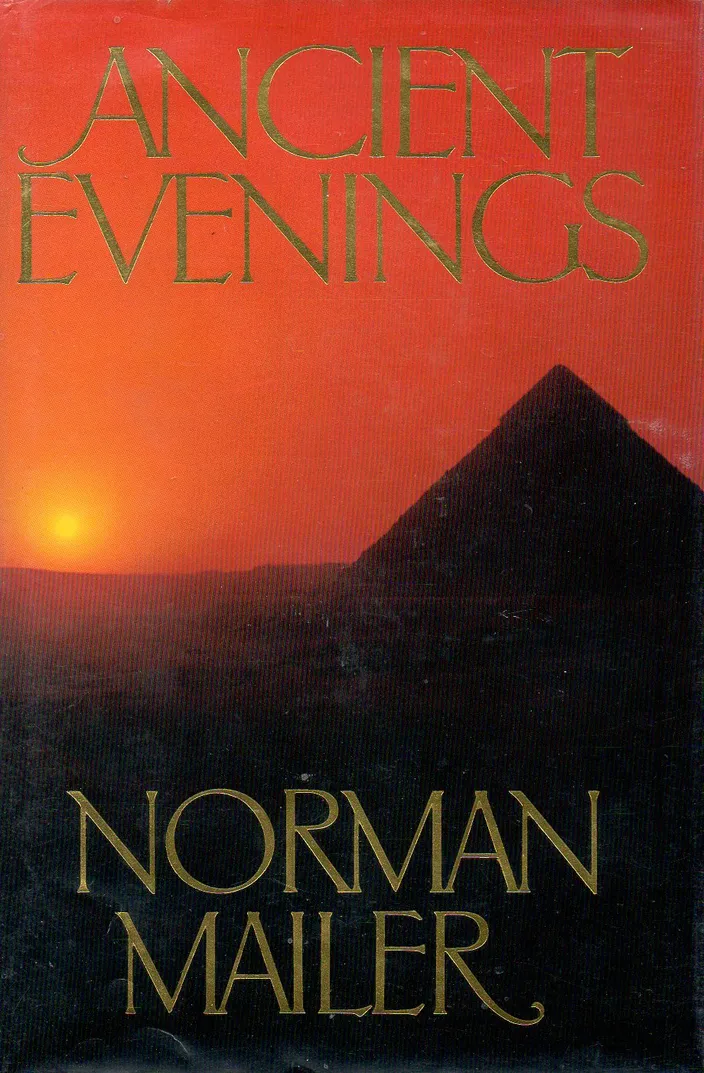
4 April — Ancient Evenings
4 April — Little, Brown published Ancient Evenings (83.18), Mailer’s 709-page novel of the Egypt of Ramses II, narrated across the seven parts of the Egyptian soul — the work of eleven years (1972–1982). Macmillan issued the British edition on 26 May. The novel drew, in Mailer’s own phrase, “my best and worst reviews,” and carried him through a months-long tour of readings and interviews — San Francisco, Chicago, Springfield, London — gathered on the novel’s page. Advance excerpts had run in the Paris Review, House and Garden, Playboy (twice), and Vogue.
August — Little, Brown to Random House
In August Mailer left Little, Brown, his publisher for two decades, for Random House on a contract reported at $4 million (83.46a, 83.46b, 83.48). Jason Epstein became his editor — “all of his future books” would be Random House — and announced that the first would be “a major contemporary novel,” the germ of Tough Guys Don’t Dance (84.17). His agent Scott Meredith managed the move.
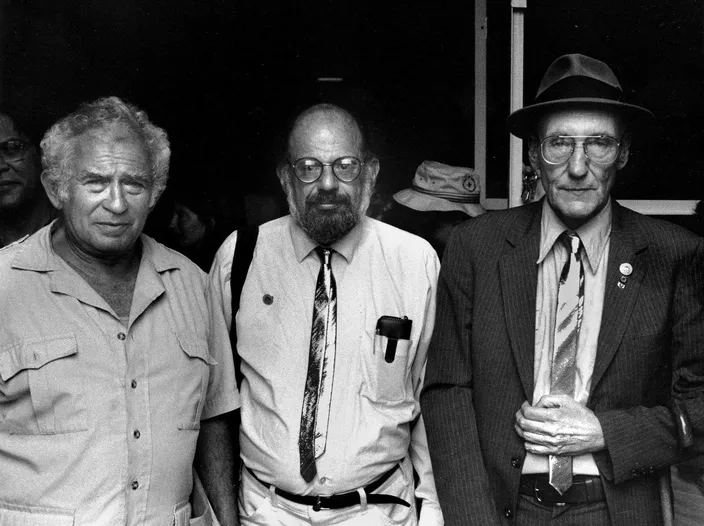
Fall — an Emmy nod, a Provincetown house, and shorter pieces
In late September Mailer was nominated for an Emmy for his screenplay of The Executioner’s Song; Tommy Lee Jones, who played Gary Gilmore, won for best actor. In October he bought the house at 627 Commercial Street, Provincetown, henceforth his year-round home there. The year’s shorter work included two Esquire pieces — the British-election essay “The Poor American in London” (83.52) and the portrait “Jackie, the Prisoner of Celebrity” (83.54) — the searching theology and Jewishness interviews with Eugene Kennedy (83.45) and Clive Sinclair (83.44), his memorial for Dwight Macdonald (83.57), and a foreword to Jean Davison’s Oswald’s Game (83.58) that prefigured his later Oswald’s Tale.
Related pages
- 1982 | 1984
- Ancient Evenings (83.18) | Random House | 627 Commercial Street, Provincetown | Jason Epstein
- Twelfth Round: An Interview with Norman Mailer (83.10) | Mailer Goes Egyptian (83.13) | The Surreal Professor (83.35) | Tough Guys Don't Dance (84.17) | The Poor American in London (83.52) | Jackie, the Prisoner of Celebrity (83.54) | God and Man and Norman Mailer (83.45) | Mailer on Moses (83.44) | Dwight Macdonald: 1906-1982 (83.57) | Foreword to Oswald's Game (83.58)