Tough Guys Don't Dance
Mailer's Provincetown murder mystery, written in sixty-one days to clear a contract debt and published by Random House on 20 August 1984 — his first novel for the house. Tim Madden, a blocked writer fresh from a divorce, wakes from a blackout to a tattooed arm, a bloody car seat, and a severed blonde head in his marijuana stash. Filmed by Mailer himself in 1986–87.
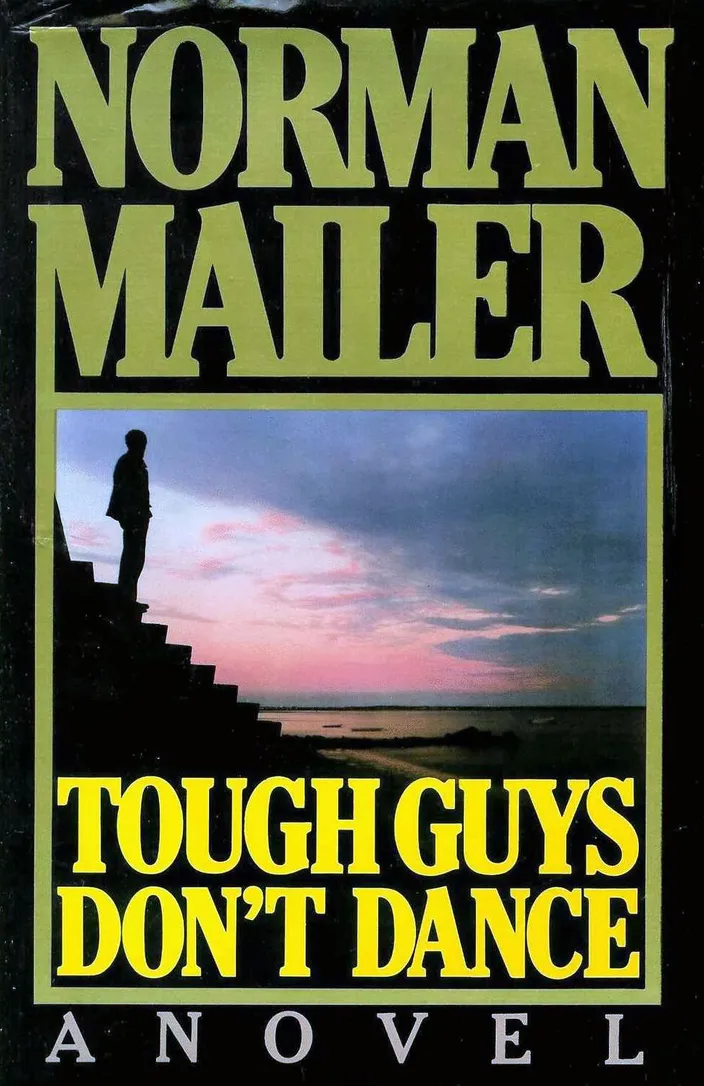
Tough Guys Don’t Dance, Mailer’s eleventh novel and his first murder mystery, published by Random House on 20 August 1984 (229 pp., $16.95; London: Michael Joseph, 15 October). It is dedicated “To Scott Meredith,” Mailer’s agent, whose deal had occasioned it; the dust-wrapper photograph is by his Provincetown neighbor Joel Meyerowitz. A simultaneous $75 signed, leather-bound Franklin Library edition carried a one-page “A Special Message for the First Edition by Norman Mailer” and his Provincetown poem “The Harbors of the Moon,” reprinted from Deaths for the Ladies (and Other Disasters) (62.3).
A novel written to clear a debt
The book was, as Mailer told interviewers all year, born “out of wedlock” (84.8): he owed Little, Brown a book under an old contract, and when the day of reckoning came he wrote it in sixty-one days — “It was one of those joke situations where they give Popeye the can of spinach” (84.24). Little, Brown declined the result; Random House, where Mailer had just signed, took it over as the first book of the new arrangement (84.6). He described it as a mystery “inspired by [Dashiell] Hammett, [Raymond] Chandler and [Georges] Simenon … the emphasis is on characters at the expense of suspense and the plot” (84.7a), and insisted he wrote it “in an entirely American idiom” (84.2). Consistent with his lifelong refusal to outline, he told the St. Louis Post-Dispatch that knowing a plot in advance “would be like being married to someone whose every habit you knew” (84.34, and see 84.30).
Synopsis
Tim Madden, a blocked writer in off-season Provincetown reeling from his wife Patty Lareine’s departure, wakes from a drunken blackout to find a fresh tattoo on his arm, blood soaking the passenger seat of his car, and — in his marijuana hiding place in the Truro woods — a severed blonde head (84.10, 84.13). Across a single late-November week of dread, deception, and accumulating bodies, Madden cannot be sure whether he himself is the killer. The early pages, much quoted, render the off-season light of Provincetown, “conceived at night … its sand flats glistened in the dawn with the moist primeval innocence of land exposing itself to the sun for the first time” (84.11) — the town reduced from its summer thirty thousand “to its honest sediment, three thousand souls” (84.17).
The friend-entrapment subplot drew on life: Mailer told People (84.20) of a federal attempt to record him incriminating his friend Buzz Farbar in a drug case — an effort that failed as to Mailer but sent Farbar to prison — and called it “especially reprehensible” “when the government tries to get a man to entrap his friend.”
Reception and bestseller run
Advance excerpts ran in Vanity Fair (chapters 1–2 in May, 84.4; most of chapters 4–5 in June, 84.7), each with Irving Penn‘s portrait of Mailer, and briefer ones in USA Today (84.10), the New York Times Book Review (84.11), Time (84.13), and the Los Angeles Herald Examiner (84.15). The novel climbed to number four on the New York Times Book Review bestseller list on 30 September. The launch — a Random House dinner for editors in Washington, D.C. in late May (84.5, 84.6, 84.8, 84.30) and a months-long American and British tour — generated the largest interview cluster of any year in the register (see the 1984 bibliography). Mailer adapted and directed the film version himself in 1986–87 (see the 1986 and 1987 entries).
Critical reception
The reviews split sharply, as Mailer’s notices habitually did. Favorable verdicts came from Harry Crews, who found the genre turn delivered “with exciting results” (St. Petersburg Times, 6 August 1984), Charles Monaghan (Wall Street Journal, 9 August), Christopher Ricks (London Review of Books, 18 October), and — with reservations — Martin Amis, whose mixed Observer notice (October 1984) he later collected in The War Against Cliché (2001). Against them stood Margaret Manning (Boston Globe, 5 August), Earl Rovit’s “The Ropewalker” (Nation, 18 September), James Campbell’s “From Dream to Dread” (Times Literary Supplement, 19 October), and George V. Higgins’s mixed “Nightmare Alley” (New York, 13 August). Denis Donoghue’s front-page “Death on the Windy Dunes” (New York Times Book Review, 29 July) set the terms of the serious debate.
Later scholarship has read the novel as a key text of Mailer’s “later fictions”: Robert Merrill placed it in the detective tradition (Norman Mailer Revisited, 1992); Ashton Howley examined its “heterophobia” (Journal of Modern Literature, 2006); Scott Duguid paired it with Ancient Evenings on “modernist history and the return of the repressed,” and James Emmet Ryan read its “diet of reality,” both in John Whalen-Bridge’s Norman Mailer’s Later Fictions (2010); and Christopher Busa surveyed how the novelist “invites his characters to dance” (The Mailer Review, 2013). Michael Glenday’s Norman Mailer (1995) treats it in the arc of the career.
The film (1986–87)
Mailer adapted his own screenplay and directed the film version in Provincetown in the fall of 1986 for Cannon Films — a roughly $5 million production shot in about seven weeks, wrapping on 13 December (86.36, 86.37, 86.39). His own house on Commercial Street served as Tim Madden’s home (86.37); Ryan O’Neal played Madden and Debra Sandlund played Patty Lareine. He described the picture as “a study of American passions, a horror story, a murder mystery, a comedy and offbeat” (86.32), and dwelt, in a string of on-set interviews, on the difference between the two crafts: “It took me two months to write the novel. The screenplay took six months” (86.38).
The film, starring Ryan O’Neal as Tim Madden with Isabella Rossellini, Debra Sandlund, Wings Hauser, and Frances Fisher, screened out of competition at the 1987 Cannes Film Festival (where Mailer sat on the jury) and opened in the United States on 18 September 1987, following a New York premiere on 16 September. It met largely hostile reviews — its first weekend grossed “a disappointing $421,390” (87.27), though it later turned a profit — and Mailer spent the fall in dozens of interviews defending it as a film that “lies somewhere in a no-man’s land between a murder mystery, a suspense tale, a film of horror and a comedy of manners” (87.7); the fullest are gathered in the 1987 bibliography, several with their own pages (Mailer by the Bay, 87.10b; Mailer’s Minuet, 87.28; the HFPA transcript, 87.23a). Per the project’s editorial policy on Mailer’s films, the picture is documented here and on the Days pages rather than given a separate film Work page.
Related pages
- A Country, Not a Scenario | The Essential Mailer (Eugene Kennedy interview) | The Prisoner of Celebrity
- Random House | Michael Joseph Ltd. | Franklin Library | Scott Meredith | Joel Meyerowitz | Provincetown, Massachusetts | Buzz Farbar
- 1984
- Deaths for the Ladies (and Other Disasters) (62.3) | Tough Guys Don't Dance (84.17) | Mailer by the Bay (87.10b) | Mailer's Minuet: 'Tough Guys' Two Left Feet (87.28) | Interview with the Hollywood Foreign Press Association (87.23a)
Referenced by 36
Works
- 50 Years Later, Reconsidering Norman Mailer's Wild, Bloody Provincetown Noir
- A Country, Not a Scenario
- An American Dream: A New Novel Serialized Exclusively in Esquire by Norman Mailer; Installment One: The Harbors of the Moon
- Deaths for the Ladies (and Other Disasters)
- Huckleberry Finn, Alive at 100
- Interview with the Hollywood Foreign Press Association
- Mailer by the Bay
- Mailer's Minuet: 'Tough Guys' Two Left Feet
- Norman Mailer: The Prisoner of Celebrity
- Novelist Mailer Turns His Latest Book into a Movie
- The Essential Mailer: Author Norman Mailer Talks about His New Novel, the Irish, and His Love for Chicago
- The Ghosts of Tough Guys Don't Dance
- Why Norman Mailer Won't Dance