Oswald's Tale: An American Mystery
Mailer's 828-page nonfiction narrative of Lee Harvey Oswald, published by Random House on 12 May 1995 — built with Lawrence Schiller from KGB files and interviews in Minsk and Dallas. Mailer concludes Oswald most likely acted alone; his aim, he said, was not to solve the case but to render Oswald's character.
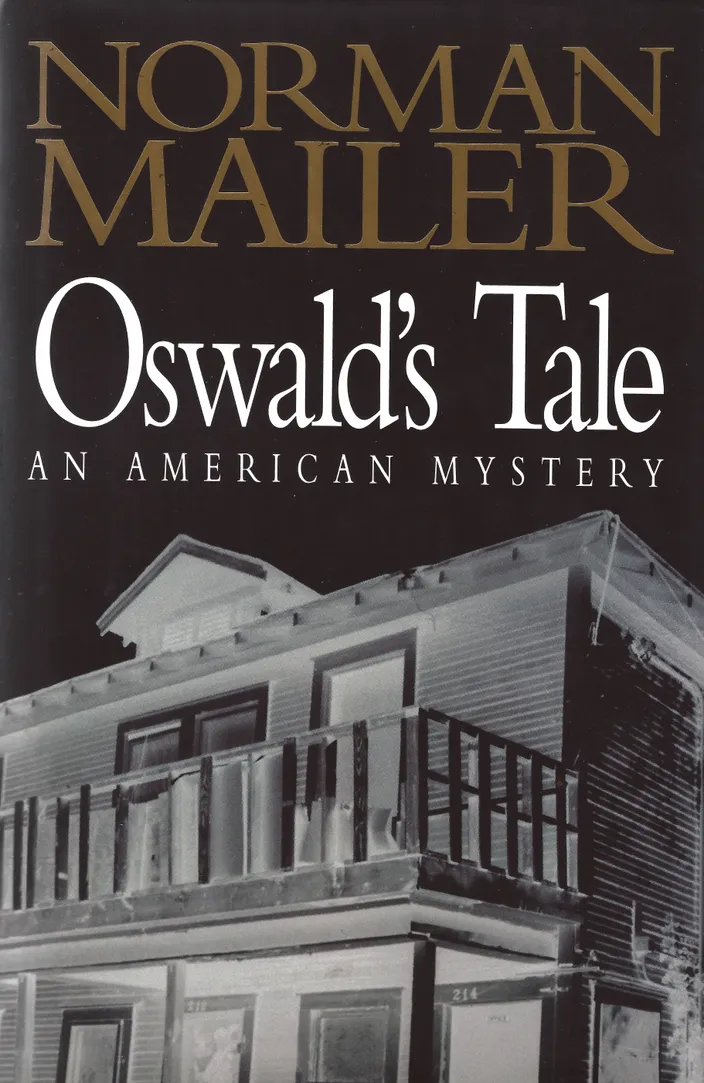
Oswald’s Tale: An American Mystery, Mailer’s nonfiction narrative of Lee Harvey Oswald, published by Random House on 12 May 1995 (828 pp., $30; London: Little, Brown, 7 September). It is dedicated “To Norris, my wife, for this book and for the other seven … these warm twenty years,” and carries a full appreciation of Lawrence Schiller — “my skilled and wily colleague in interview and investigation” — and his assistant Judith McNally.
The book
The book grew from six months Mailer and Schiller spent in 1992–93 in Minsk, Moscow, and Dallas, drawing on KGB surveillance files newly opened in Belarus and on interviews — including five days with Marina Oswald. Volume one, “Oswald in Minsk with Marina,” reconstructs the Soviet years; volume two, “Oswald in America,” the return and the assassination. Mailer, once a conspiracy theorist, came away “75 percent sure” Oswald acted alone — “I think he did it by himself, but … he was leaned on by the FBI and CIA” (95.9) — but insisted his purpose was character, not verdict: “The intent of Oswald’s Tale … is not to solve the case — that’s beyond my means — but to delineate for the reader what kind of man he was” (95.27). A signed Franklin Library edition appeared simultaneously with a special preface.
Reception
Advance excerpts ran in The New Yorker (“Oswald in the U.S.S.R.: Annals of Surveillance,” 95.8), the New York Review of Books (“The Amateur Hit Man,” 95.15), and Parade (95.17), and Mailer toured twelve cities. The reviews divided. Favorable notices came from Robert Stone (New York Review of Books), Paul Berman (New Republic), Martin Amis (“Fatally Flawed,” Times, London), Allan Massie, and Andrew O’Hagan (London Review of Books); John W. Aldridge (Atlantic) and William T. Vollmann (Village Voice) were mixed; Michiko Kakutani (New York Times) and Patricia Holt (San Francisco Chronicle) were negative — Kakutani’s pan provoking a public complaint from Mailer (95.36). The book was reprinted heavily in The Time of Our Time (98.7).
Related pages
- Lee Harvey Oswald | Lawrence Schiller | Random House
- Portrait of Picasso as a Young Man (the year’s other book)
- 1995
- Foreword to Oswald's Game (83.58) | Big Dealy: Dallas Postcard (93.8) | Oswald's Ghost: An Interview with Norman Mailer (96.2) | Norman Mailer (97.26)
- The Time of Our Time (98.7)