1975
A pivotal personal year. In March Mailer meets Barbara Norris - the future Norris Church Mailer, his sixth and last wife - in Arkansas through his army friend Fig Gwaltney. In July he publishes The Fight, his account of the Ali-Foreman 'Rumble in the Jungle' and the last of his eight consecutive third-person books. In December he separates from Carol Stevens and moves to Brooklyn with Norris and her son Matthew. The two-part Rolling Stone interview opens the year with his fullest talk yet on God and the Devil.
Winter — God and the Devil
The year opened with the two-part Rolling Stone interview by Richard Stratton, with Annie Leibovitz photographs: “Aquarius Hustling” (75.1) on Marilyn, and “Sympathy for the Devil” (75.2), Mailer’s longest discussion of God and the Devil since 1959. His Fifth Estate activity continued in Counter-Spy (75.4) and a Wichita speech (75.6).
March — meeting Norris
In March, in Arkansas, Mailer met Barbara Norris — later Norris Church Mailer — introduced by his army friend Francis “Fig” Gwaltney. She would become his sixth and last wife.
Summer — The Fight
The Ali–Foreman narrative ran first in Playboy in May and June (“The Dead Are Dying of Thirst,” 75.8; “All Night Long,” 75.9), which together won Playboy’s best-nonfiction award.
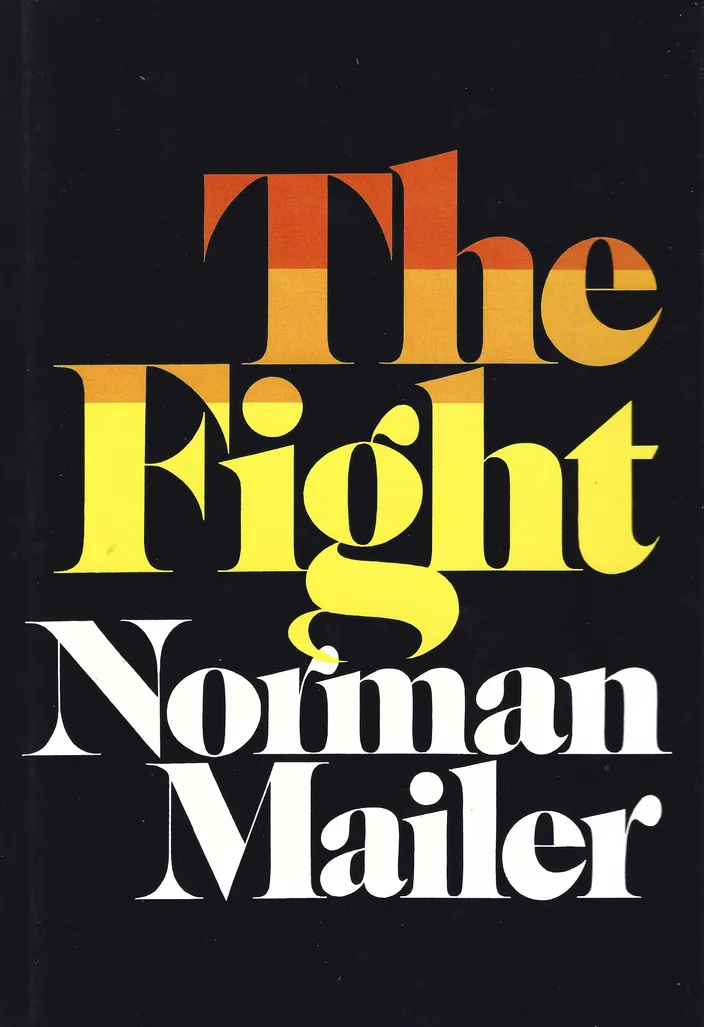
21 July — Little, Brown published The Fight (75.12), Mailer’s account of the Ali–Foreman “Rumble in the Jungle” of 30 October 1974 in Zaire. It is the last of the eight consecutive books in which Mailer narrates himself in the third person (illeism). Laura Adams‘s “Existential Aesthetics” (75.11) appeared in Partisan Review the same season, and Stan Isaacs drew out his longest boxing interview that September (75.13).
Fall — Brooklyn
In November Mailer prefaced the Burnetts’ Fiction Writer’s Handbook (75.14), recalling his Harvard apprenticeship. In December he separated from Carol Stevens and began living in Brooklyn with Norris Church and her son Matthew — the household that would anchor the rest of his life.
Related pages
- 1974 | 1976
- The Fight (75.12) | God and the Devil | Illeism (the third-person self)
- Norris Church Mailer | Muhammad Ali | George Foreman
- The Rolling Stone Interview, Part I: Aquarius Hustling (75.1) | The Rolling Stone Interview, Part II: Sympathy for the Devil (75.2) | The CIA vs. Democracy (75.4) | CIA, FBI 'Threaten Nation' (75.6) | The Dead Are Dying of Thirst: The Fight, Part I (75.8) | All Night Long: The Fight, Part II (75.9) | Existential Aesthetics: An Interview with Norman Mailer (75.11) | Norman Mailer: I'm Like a Minor Champ (75.13) | Preface to Fiction Writer's Handbook (75.14)
Referenced by 24
Works
- A Preface to The Joker
- All Night Long: The Fight, Part II
- Before He's Naked or Dead, Norman Mailer Goes for Broke: The Biggest Novel of All
- CIA, FBI 'Threaten Nation'
- Existential Aesthetics: An Interview with Norman Mailer
- Norman Mailer: Humor Saves Day for the Man of La Mancha
- Norman Mailer: I'm Like a Minor Champ
- Preface to Fiction Writer's Handbook
- The CIA vs. Democracy
- The Dead Are Dying of Thirst: The Fight, Part I
- The Fight
- The Meaning of Vietnam
- The Murder File
- The Rolling Stone Interview, Part I: Aquarius Hustling
- The Rolling Stone Interview, Part II: Sympathy for the Devil