1949
Mailer follows the NAD year with a politically volatile one. In March he speaks at the 25–27 March Waldorf Conference — his "Trojan horse" remarks denounce both U.S. monopoly capitalism and Soviet state capitalism, generating four reception pieces in politics, the New York Times, the National Guardian, and the New Republic, and the official NCASP transcript. Soon after he breaks with the Progressive Party. By June the Mailers are in Hollywood for the summer, where Jean and Galy Malaquais join them; Mailer works on — and refuses to sell — a Samuel Goldwyn screenplay, drafts and abandons a labor-unions novel, pushes on with Barbary Shore, meets Lois Mayfield Wilson, and (28 August) becomes a father: Susan Mailer is born to Bea.
Winter
February 12 — Rochelle Girson’s group interview “‘48’s Nine” (49.2) appears in Saturday Review, surveying nine young novelists who debuted or broke through in 1948 — Mailer among them alongside Truman Capote, Irwin Shaw, and six others.
March — the Waldorf Conference
March 25–27 — Mailer attends the Cultural and Scientific Conference for World Peace at the Waldorf-Astoria Hotel in New York — the “Waldorf Conference,” sponsored by the National Council of Arts, Sciences and Professions (the same NCASP behind the 11 October 1948 rally).
March 26 — Mailer delivers his floor remarks, opening: “I have come here as a Trojan horse.” He denounces the state capitalism of the U.S.S.R., the monopoly capitalism of the United States, and the futility of the conference itself. The authoritative transcript appears in the NCASP’s Speaking of Peace (49.5), pp. 82–83.
Mailer meets Dwight Macdonald, Mary McCarthy, and Robert Lowell at the conference. A Macdonald report (49.1) on the conference runs in politics 6 (winter 1949, the journal’s final issue). Life attacks the conference as a Communist front in its 4 April issue (39–43).
March 27 — The New York Times closes its three days of conference coverage with a wrap-up, “Panel Discussions of the Cultural Conference Delegates Cover a Wide Range of Subjects” (49.2a), which quotes Mailer’s “Trojan horse” opening.
April
April 4 — Cedric Belfrage’s “Guardian Reports on the Peace Conference Panels” (49.2b) in the National Guardian quotes Mailer calling for “a decent equitable socialism”.
April 18 — Joseph P. Lash’s “Weekend at the Waldorf” (49.2c) in The New Republic — another long-excerpt Waldorf reception piece.
Spring — break with Progressive Party; labor-unions novel
Soon after the Waldorf Conference, Mailer breaks with the Progressive Party for which he had campaigned so strenuously through the fall of 1948. He begins, researches, and drops a novel about labor unions — an abandoned project left uncounted in his published bibliography.
May — the Sunday Times and the British obscenity debate
May 1 — An Associated Press wire carries Mailer’s reply to the London Sunday Times‘s condemnation of The Naked and the Dead (49.3): the book’s obscenity is “like a bell ringing in the background while you work. Before long you don’t notice it anymore.” The possible banning of NAD is discussed on the floor of the House of Commons; the British Attorney General, Sir Hartley Shawcross, calls the novel “foul, lewd and revolting” but declines to prosecute.
May 9 — London publication of NAD by Wingate — the British first edition that had been at the heart of the obscenity debate.
June — Hollywood
In June the Mailers move to Hollywood for the summer. Jean and Galy Malaquais join them. Mailer and Malaquais work, unsuccessfully, on screenplays for Samuel Goldwyn. Goldwyn rejects Mailer’s script but reportedly offers $15,000 for “the idea,” which Mailer refuses to sell. Mailer later said to Steven Marcus: “I think [Barbary Shore] reflected the impact of Hollywood on me in some subterranean fashion”.
In Hollywood Mailer meets Lois Mayfield Wilson, a Stanford graduate student with whom he has, in Lennon’s phrasing, “a life-long … relationship.” See her page for detail.
July
23 July — Banquet in Los Angeles honoring James Kutcher, the legless WWII veteran dismissed from the Veterans’ Administration for his Socialist Workers Party affiliations. Mailer serves on the national committee to defend Kutcher and contributes a statement (49.6) to the event’s souvenir program — a sharp anti-McCarthyite text describing the persecution of left-wing political actors as “a direct indication of the strength of fascism in America.” Mailer may have attended the banquet; he was in Hollywood that summer.
August — Susan Mailer born
28 August — Susan Mailer is born to Bea — Mailer’s first child.
October — Arts, Sciences and Professions Council panel
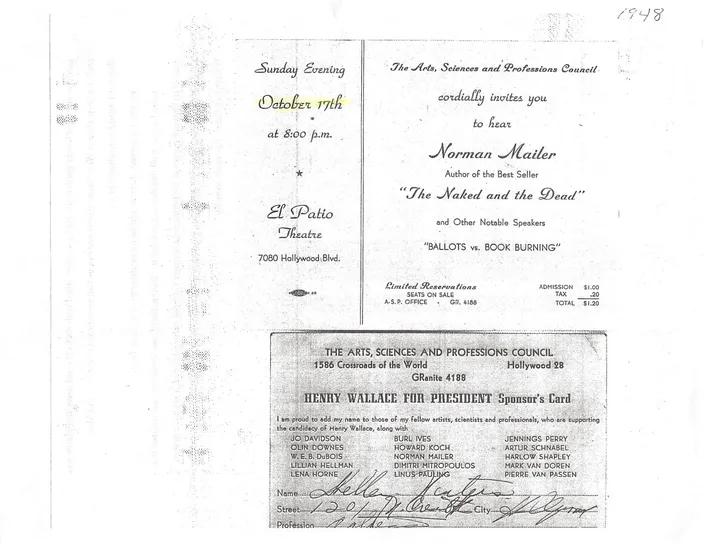
October — While in California, Mailer appears as a panelist at an Arts, Sciences and Professions Council event at the El Patio Theatre (exact date and topic per the surviving invitation, to confirm) — a West Coast counterpart to the NCASP activity that bracketed his year.
Summer and fall — Barbary Shore continues
Mailer finishes the first draft of Barbary Shore in Hollywood. Work continues; the novel will not be published until May 1951. See 1950 and 1951.
The year in publication
Lennon records nine 1949 Mailer-related bibliography entries (49.1–49.6, with subentries 49.2a, 49.2b, 49.2c). Three are by Mailer (49.4, 49.5, 49.6) and six quote or interview him. In a year bookended by the NAD year and the Barbary Shore year, Mailer’s own published output is largely political — a Harvard class statement, the Waldorf speech, and the Kutcher-defense statement — while five other writers take his measure in reviews and reports of his public appearances. The Saturday Review interview is one of only two formal interviews Mailer gives between NAD and The Deer Park (1955). See 1949 bibliography for the full register.
Related pages
- 1948 | 1950
- The Waldorf Conference | '48's Nine | Panel Discussions of the Cultural Conference Delegates Cover a Wide Range of Subjects | Guardian Reports on the Peace Conference Panels | Weekend at the Waldorf | Reply to the Sunday Times on The Naked and the Dead | Statement for Class Record | Speaking of Peace: An Edited Report of the Cultural and Scientific Conference for World Peace | Statement in Support of James Kutcher
- Susan Mailer | Dwight Macdonald | Lois Mayfield Wilson | Samuel Goldwyn | James Kutcher | Mary McCarthy | Robert Lowell
- National Council of the Arts, Sciences and Professions | politics | The New Republic
- Hollywood, California
Referenced by 24
Works
- '48's Nine
- Guardian Reports on the Peace Conference Panels
- Panel Discussions of the Cultural Conference Delegates Cover a Wide Range of Subjects
- Reply to the Sunday Times on The Naked and the Dead
- Speaking of Peace: An Edited Report of the Cultural and Scientific Conference for World Peace
- Statement for Class Record
- Statement in Support of James Kutcher
- The Waldorf Conference
- Weekend at the Waldorf